
Introduction
In the field of product development, especially in the manufacturing of complex metal components, teams often rely excessively on static design drawings or basic models. This approach leads to a common pain point: misunderstandings during prototype iterations, necessitating repeated modifications, and ultimately causing project delays and cost overruns. The core issue lies in the fact that traditional methods lack dynamic visualization capabilities and rapid physical validation, meaning design defects are often not discovered until the later stages of development, when the cost of correction is highest. Although video animation can vividly showcase concepts, it cannot fully replace physical testing.
This article will delve into how to seamlessly integrate engineering animation with precision metal rapid prototyping technologies like CNC machining and 3D printing to create a closed-loop process from virtual design to physical object, ensuring high consistency between the conceptual model and the final part, thereby fundamentally solving the aforementioned problems.
Why is Product Animation Essential for Reducing Errors in Prototyping?
In the early stages of product development, product animation plays the role of a “virtual touchstone.” Through dynamic, multi-angle 3D animation, designers and engineers can comprehensively examine the product’s movement mechanisms, assembly relationships, and potential interferences before investing in any physical materials.
This early visualization capability is key to reducing errors in prototyping iterations. According to the American Society of Mechanical Engineers (ASME), effective visualization is the cornerstone of engineering decision-making and can significantly reduce design rework caused by poor communication or misinterpretation.
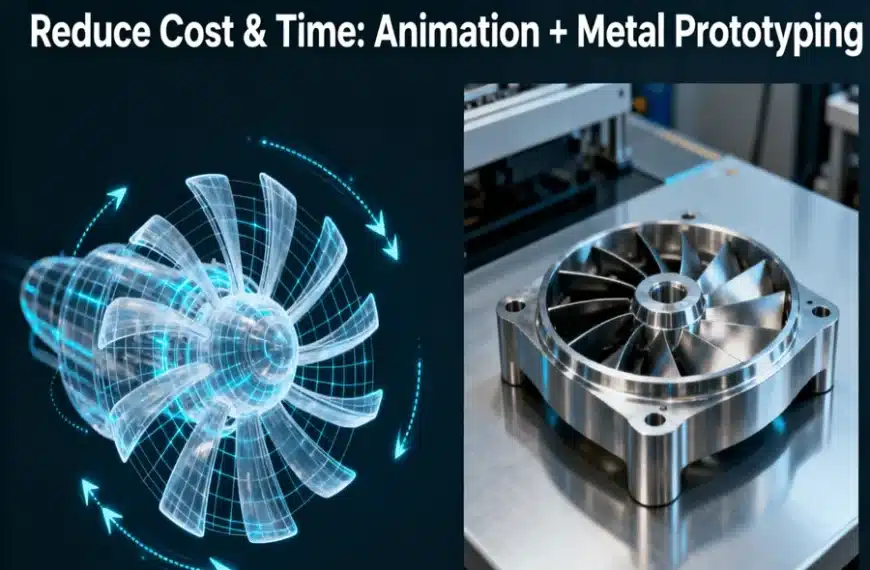
The value of product animation becomes even more pronounced when combined with metal rapid prototyping technology. Animation first validates the functionality of the design in a virtual environment, identifying the vast majority of obvious or hidden issues. Subsequently, proceeding directly with metal rapid prototyping based on this optimized 3D model ensures that the manufactured physical prototype closely aligns with the design intent.
This approach avoids the costly cycle of “manufacture-test-identify problem-modify design-remake” inherent in traditional processes. For example, a complex gearbox mechanism can be simulated in advance through animation to detect potential kinematic interference before producing high-precision prototype parts via CNC machining. This minimizes the number of physical iterations, directly saving costs and time. To learn more about this process, please refer to the metal rapid prototyping guide.
How Can the 3D Model to Video Process Enhance Physical Prototype Accuracy?

Figure 2: The iterative closed-loop process integrating animation and rapid prototyping, ensuring
design flaws are caught early.
The 3D Model to Video Workflow
The 3D model to video process begins with a high-precision CAD model. Designers use rendering and animation software to assign materials, lighting, and motion paths to the model, generating a video that accurately reflects the product’s appearance and function. This process itself serves as a rigorous inspection.
Ensuring Precision in Manufacturing Transition
During the conversion process, CNC machining rapid prototyping technology plays a crucial role. It can directly read the CAD data validated by animation, machining functional prototype machined parts with very tight tolerances. This seamless data flow ensures high consistency from the digital model to the physical part.
- Geometry Validation
Animated videos can display the product 360 degrees, allowing both the design team and manufacturing engineers to jointly review every detail, ensuring the 3D data is complete and accurate before entering the manufacturing stage.
- Tolerance and Fit Analysis
By dynamically demonstrating the assembly process, animation can preliminarily verify whether the fit tolerances between parts are reasonable. This provides clear guidance for subsequent CNC rapid prototyping, avoiding part scrapping due to improper tolerance design.
- Seamless Data Transmission
A high-quality 3D model to video process implies lossless transmission of CAD data from design to manufacturing. This ensures that the machining data read by the CNC machine tool is completely consistent with the animated model, guaranteeing the accuracy of the prototype parts from the source.
The Role of CNC Machining in the Loop
CNC machining rapid prototyping is key to achieving high-precision metal prototypes. It transforms virtual designs into solid parts with exceptional accuracy, and the material properties are highly consistent with the final product, providing a reliable physical basis for subsequent testing.
What Role Does Engineering Animation Play in Complex Assembly Validation?
For complex mechanical systems comprising hundreds of parts, the value of engineering animation in assembly validation is irreplaceable. It can simulate the entire assembly sequence, disassembly process, and the kinematic relationships of internal components, exposing spatial conflicts, tool accessibility issues, and installation sequence errors that are difficult to detect in static drawings.
Virtual assembly validation through engineering animation can significantly reduce risks and uncertainties in physical assembly testing. Once virtual validation is passed, teams can utilize rapid prototyping services to quickly manufacture key components for physical assembly testing. Particularly for parts with complex internal channels or integrated structures, metal 3d printing rapid prototyping technology can directly produce parts that are impossible to make with traditional methods, perfectly complementing animation simulation.
The National Aeronautics and Space Administration (NASA) has repeatedly emphasized in its technical reports that using advanced animation and simulation for prototype testing is a crucial means of reducing space mission risks and ensuring system reliability. For instance, in the development of a satellite robotic arm, simulating its deployment and grasping actions through animation, followed by rapid manufacturing of joint components via metal 3D printing, greatly shortens the development cycle and ensures reliable performance in extreme environments.
How to Optimize CAD Design for Both Animation and Cost-Effective Manufacturing?
Design Principles for Dual Purpose
Optimized CAD design is the hub connecting efficient animation rendering with economical manufacturing. A well-designed model should meet both visual effect requirements and manufacturability requirements, thereby effectively controlling metal prototyping cost. Firstly, the model must be “Watertight,” meaning no surface breaks or gaps, which is a prerequisite for high-quality animation rendering and a basic requirement of all manufacturing processes for data. Secondly, reasonable wall thickness design is crucial; too thin may lead to manufacturing failure or insufficient strength, while too thick increases weight and metal prototype cost.
Designing for Specific Processes: Sheet Metal Example
Rapid sheet metal prototyping requires CAD design to fully consider material characteristics and manufacturing processes. For example, bend radii and bend relief must be clearly defined in the design. Animation can intuitively show the bending process, while correct design can prevent cracking or deformation during manufacturing.
- Bend Radii and Relief
Accurate bend radius design is the foundation of sheet metal forming, directly affecting the part’s accuracy and strength.
- K-Factor Considerations
Setting the K-factor reasonably is key to calculating the blank development size of sheet metal, which directly affects material utilization and the dimensional accuracy of the final part, crucial for cost control.
- Hardware Integration
For sheet metal parts requiring pressed nuts or screws, positions and hole diameters should be precisely reserved in the CAD model. Animation can verify their installation feasibility, while the manufacturing end can execute accurately.
Balancing Aesthetics and Manufacturability
The table below compares the impact of different design choices on animation effects and manufacturing costs:
| Design Choice | Benefit for Animation | Impact on Manufacturing Cost |
| Overly small fillets/chamfers | Visually “sharper” effect | Increases machining difficulty and time, cost rises significantly |
| Unnecessary complex surfaces | Potentially more artistic | CNC machining or mold costs increase dramatically |
| Integrated design (reducing part count) | Cleaner animation assembly | May reduce assembly costs, but cost per single part may be higher |
Adhering to standards like AS9100D, an aerospace-grade quality certification, means that strict specifications are incorporated from the CAD design stage, ensuring controllability and high quality throughout the entire process from animation to rapid sheet metal prototyping and even mass production. To learn more, please check our rapid prototyping services.
What Are the Key Factors Affecting Metal Prototyping Cost and How to Manage Them?
Effectively managing metal prototyping cost is key to project success. The main factors affecting cost include: part complexity (more complex geometries increase machining time and programming costs), material selection (e.g., aluminum alloy costs less than titanium alloy), production process (CNC, 3D printing, rapid sheet metal prototyping, etc., each have different cost structures), and quantity (unit cost is usually higher for single pieces; small batches can amortize initial setup costs).
To manage these costs effectively, it is first essential to involve rapid prototyping services suppliers early in the prototyping stage. Their manufacturing experience can provide Design for Manufacturability (DFM) advice for CAD design, optimizing the design from the source to reduce costs. Secondly, fully leveraging product animation for early-stage validation avoids the cost of repeated manufacturing due to design errors, which is the biggest area for cost savings.
Industry data shows that over 40% of prototype costs are wasted on solving problems that could have been avoided in the design stage. By integrating the synergistic process of product animation and metal rapid prototyping, teams can perform multiple “free” iterations in the virtual world, proceeding with physical manufacturing only after the optimal solution is determined. This integrated approach not only directly reduces the cost per metal prototype but also significantly lowers the overall project expenditure by reducing the number of iterations and shortening the development cycle.
Conclusion
This article has detailed the powerful synergistic effect between product animation and metal rapid prototyping technologies. By combining dynamic visualization with rapid physical validation, enterprises can identify and solve problems early in the development phase, thereby minimizing development risks, costs, and time. This integration strategy opens a fast track from concept to market and is a key competitive advantage for modern enterprises. Contact professional team now to obtain customized prototype solutions and optimize your product development process!
Author Bio
The author of this article is a precision manufacturing expert with over 10 years of experience in the rapid prototyping field, dedicated to helping teams achieve efficient product development. JS Precision provides industry-leading manufacturing services. The company has passed international quality system certifications such as ISO 9001, IATF 16949, ISO 13485, and AS9100D, ensuring full-process quality control from design to manufacturing.
FAQs
Q1: What is the main advantage of using product animation in prototyping?
A: Product animation allows teams to visualize designs dynamically, identifying errors early and reducing physical iteration costs by up to 30%, ensuring smoother transitions to manufacturing.
Q2: How does metal rapid prototyping differ from traditional methods?
A: Metal rapid prototyping uses technologies like CNC machining and 3D printing to create physical parts faster, with higher precision and lower waste, compared to slow manual techniques.
Q3: Can engineering animation replace physical testing entirely?
A: No, engineering animation complements physical testing by simulating conditions, but real-world prototypes are essential for validating durability and performance under actual stresses.
Q4: What factors most influence metal prototyping cost?
A: Key factors include part complexity, material type, and production volume; optimizing CAD designs and choosing the right service can help control expenses effectively.
Q5: How do certifications like ISO 9001 benefit prototyping services?
A: Certifications ensure consistent quality and adherence to international standards, reducing risks and enhancing reliability in prototype production for various industries.


