
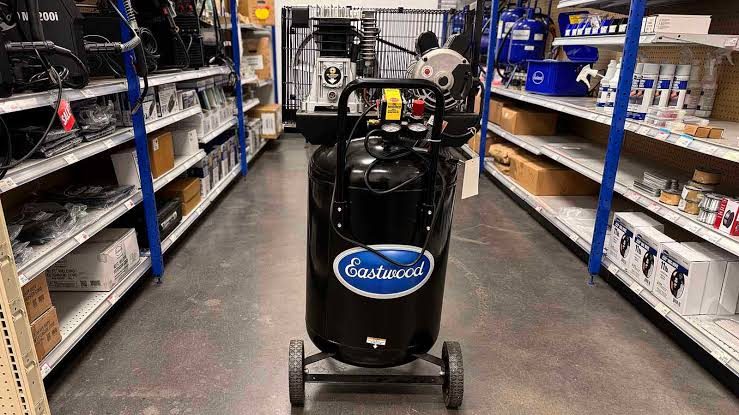
A compressor can look perfectly sized on paper and still leave the tool at the end of the hose gasping. The number stamped on the machine is a measurement taken at the discharge port. The tool lives 50 or 100 feet away, through a run of hose, a few couplers, and whatever elbows the shop happened to have on the shelf.
Follow one example through the rest of this piece: a sandblasting setup with a 3/8" (#6) nozzle running at 100 psi. Physics fixes the nozzle demand. Everything between the compressor and that nozzle is a choice, and every choice costs pressure.
The Nozzle Sets the Floor, Not the Ceiling
A #6 nozzle at 100 psi wants somewhere around 196 CFM of clean, dry air. That number is the floor the compressor has to clear at the nozzle, not at its own gauge. Operators who miss the distinction buy a compressor rated for 200 CFM, hook it up to whatever hose is coiled by the door, and wonder why the blast pattern looks tired by lunch.
Most equipment suppliers tell you to size the compressor meaningfully above the nozzle's rated demand so there's headroom for the losses that follow. A thorough primer on sizing compressors for sandblasting walks through how nozzle CFM, operating PSI, duty cycle, and downstream losses stack up into the number you actually need to buy.
Think of that headroom as a budget for everything in the next two sections, not as a cushion for comfort.
Hose Length and Diameter Spend That Budget Fast
Hose is the single biggest line item in the loss budget. Two variables drive it: internal diameter and length, and diameter dominates. VMAC's worked example shows a 100-foot, 1-inch hose carrying 100 CFM at 90 psi loses about 3.35 psi, and stretching that same hose to 300 feet pushes the loss to roughly 10.1 psi. Same air, same compressor, three times the hose, and the nozzle takes a measurable pressure cut.
Shrink the diameter and the math gets ugly fast. The same reference shows that pushing 70 CFM across 100 feet costs about 1.4 psi through a 1-inch hose and about 44 psi through a half-inch hose.
Back to the #6 nozzle. Feed it through 150 feet of undersized hose and the compressor could be delivering a textbook 100 psi while the nozzle sees 70. The blast slows, the operator leans on the trigger longer, and the job quoted at four hours runs six.
Fittings and Couplers Are the Silent Tax
Every quick-connect, every elbow, every reducer adds restriction. Each one looks trivial in isolation. Add them up and they often match the loss of the hose itself.
A walkthrough from Pneumatic Tips on sizing air tool fittings runs a tool through 25 feet of quarter-inch hose with two quick-connect couplers and gets about 32 psi of loss from the hose alone, with the couplers piling on more. Upsize the hose and couplers to 3/8" and the hose loss collapses to a few psi, with per-coupler loss falling to around a psi each.
On the sandblasting rig, the usual culprits are:
- Undersized quick-connects. The coupler at the compressor and the one at the tool are often the narrowest point in the entire line. Match them to the hose ID, not the other way around.
- Reducer bushings. Dropping from a 1" outlet to a 3/4" hose with a bushing creates a step the air has to squeeze through every second of the job.
- Tight-radius elbows. Sweeping elbows cost far less pressure than hard 90s. On long runs, the difference adds up.
- Leaks at the joints. A loose fitting isn't a harmless hiss. Across a shift it can bleed off a meaningful share of the compressor's output, and the operator never notices until the tool slows.
The 10 Percent Rule Is the Honest Target
According to the U.S. Department of Energy's compressed air sourcebook, a well-designed compressed air system should lose less than 10 percent of discharge pressure between the compressor and the point of use. That benchmark is a useful yardstick for a portable sandblasting rig too. At 100 psi discharge, you have 10 psi to spend across the whole run.
Ten psi disappears quickly. A long hose eats a few, the couplers chew through more, and a clogged filter or a cheap regulator can finish off whatever's left.
If the rig is losing 25 or 30 psi by the time the air reaches the nozzle, a compressor upgrade is unlikely to fix it on its own. You'll be feeding a bigger machine into the same restriction.
Size the compressor above the nozzle. Size the hose and fittings for the distance. Measure pressure at the tool, not at the tank. The #6 nozzle will tell you whether the math worked.


