
Introduction
In the competitive race of product development, delay is the greatest silent profit eroder. When competitors beat you to market, even the most innovative products can lose their competitive edge. Crucially, the root cause of many delays is not found on the manufacturing floor but is predetermined during the design phase.
The traditional linear development process – completing a design before handing it off to manufacturing – carries significant risk. This often leads to the discovery of critical manufacturability issues only during trial production, triggering expensive design changes, mold reworks, and production schedule disruptions.
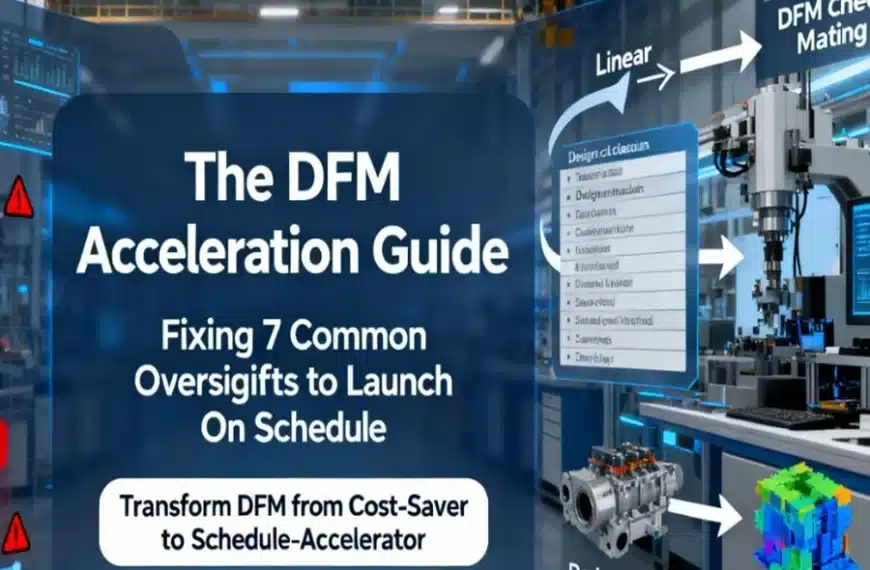
This guide serves as a strategic acceleration tool, revealing seven of the most common design oversights and providing concrete, actionable solutions to fix them. Its core purpose is to transform DFM (Design for Manufacturing) from a post-design check into a proactive acceleration strategy. By systematically addressing these seven areas, development teams can significantly compress their development cycles, ensuring products launch on time or even ahead of schedule.
Why is DFM the Cornerstone of Predictable Product Launches?
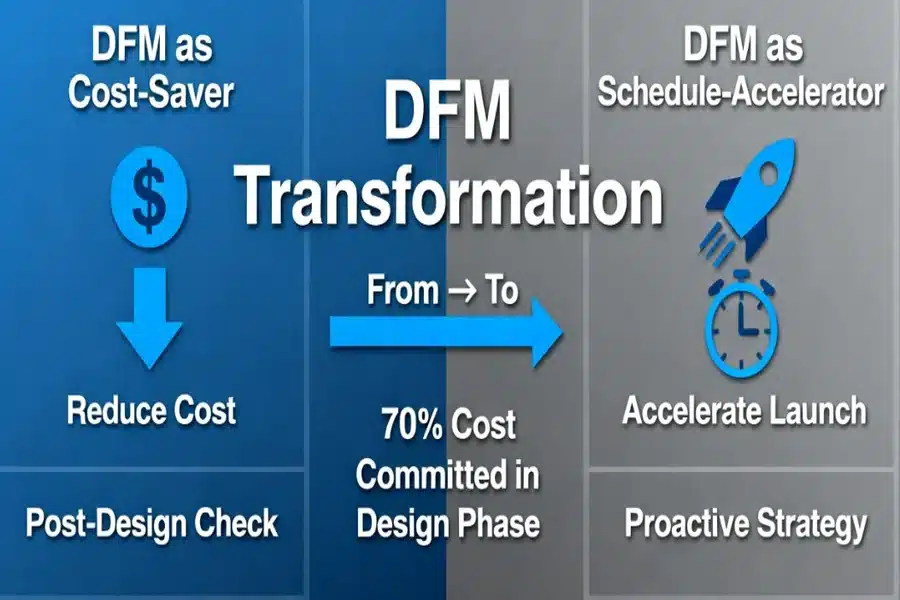
DFM (Design for Manufacturing) is often misunderstood as merely a cost-control tool, but its more critical role is as a “stabilizer” and “accelerator” of the project timeline. True DFM means considering manufacturing requirements and constraints from the very beginning of the design process, using early virtual validation and risk elimination to avoid disruptive changes later, thereby ensuring the project stays on plan.
- The Exponentially High Cost of Late-Stage Changes: Research consistently shows that 70% to 80% of a product’s total cost is committed during the design phase. The cost of implementing a change increases exponentially after the design is released. A design flaw that might cost 100 to fix during prototyping could exceed 10,000 to correct if it reaches the production tooling stage. The core value of DFM lies in identifying and solving problems at the least expensive phase.
- Shifting from Sequential to Concurrent Engineering: The Society of Manufacturing Engineers (SME) states that “Concurrent Engineering” is a key practice for shortening product development cycles. This involves close collaboration between design and manufacturing teams from the concept stage, breaking down departmental silos and injecting manufacturing knowledge upfront to eliminate manufacturability risks at their root.
How Does Designing Without Regard for Material Lead Times Create Bottlenecks?
Selecting special, custom, or long-lead-time materials is a common and preventable cause of project delays. Ignoring material availability and supplier lead times can leave a project stuck in passive waiting.
- The risks of “exotic” material selection: Engineers may select idealized materials for optimal performance, but if those materials are only available from a few suppliers with lead times of several months, the entire project schedule becomes dependent on DFM principles require treating material availability as a key early design input.
- The strategic advantage of standard material libraries: Creating and utilizing a standard material library is an effective strategy to mitigate supply chain risks. Prioritizing common-specification, readily available materials not only shortens procurement times but can also reduce costs through supplier economies of scale, ensuring project progress is not hindered by material supply.
Are Your Tolerance Specifications Causing a Validation Loop Quagmire?
Unreasonable tolerance design is a primary factor leading to validation quagmires and project delays. Overly tight or functionally unclear tolerances can cause assembly interference and functional failures, triggering cycles of repeated sample validation, inspection, and rework.
- Understanding the Validation Quagmire: When a part fails its First Article Inspection due to tolerance issues, the entire process can fall into a “modify-remanufacture-revalidate” loop. Each iteration means days or even weeks of delay, plus additional consumption of human and material resources.
- Implementing a Functional Tolerancing Strategy: The solution is to implement functional tolerancing. Through a “Critical Function Analysis,” identify which dimensional features truly impact the product’s assembly, function, or safety, and consciously relax tolerances on non-critical dimensions. Adherence to international standards like ASME Y14.5 provides a clear framework for reducing ambiguity and communication costs.
Could an Unnecessarily Complex Assembly Process Be Your Biggest Schedule Killer?
Complex assembly designs drastically reduce production line speed, increase training time, and raise error rates, becoming an invisible killer of progress.
1.The Accumulated Cost of Assembly Complexity
Every additional fastener, every non-error-proofed design feature, translates to more operational steps, longer assembly times, and a higher probability of errors. These minor delays accumulate into significant time losses at mass production scale.
2.Simplifying Assembly through Design Innovation
DFM best practices advocate for simplifying assembly paths through part consolidation and modular design. For instance, combining multiple components into a single integrated structure, or designing self-locating, error-proofed interfaces, can dramatically improve assembly efficiency.
- Value Integration Case Study: In a Design for Manufacturing analysis of a precision fluid control component, consolidating multiple parts into a modular design eliminated assembly ambiguity and reduced the production cycle from weeks to days, ensuring on-time delivery.
What is the Impact of Ignoring Factory-Specific Process Capabilities on Your Timeline?
A design that does not match the specific equipment and process capabilities of the chosen factory can lead to inability to produce or require expensive equipment modifications/outsourcing, directly causing delays.
1.Bridging the “Theoretical Design” and “Manufacturing Reality” Gap
A design may be flawless in software but exceed the travel limits of the partner factory’s largest machine or be incompatible with standard injection molding machine tonnage. This disconnect can force the factory to seek special equipment or propose high-cost solutions, directly impacting the project timeline.
2.The Necessity of Early Manufacturing Feasibility Assessment
The key is to conduct an early process feasibility assessment with the manufacturing partner. Before final design freeze, review preliminary models jointly to ensure the design is compatible with their existing equipment capabilities, tooling, and standard processes.
How to Institutionalize a Proactive DFM Review Process for Repeatable Success?
To maximize the benefits of DFM, it must be transformed from an ad-hoc activity into an institutionalized, repeatable process.
1. Building a Cross-Functional DFM Team
Successful design-manufacturing collaboration relies on a stable, cross-functional team including design engineers, manufacturing engineers, procurement, and quality specialists. This team participates in design reviews at critical milestones.
2. Implementing Gated Reviews and Standardized Checklists
Establish design review gates at key points like concept design, detailed design, and production readiness. Use standardized DFM checklists for systematic review. This ensures all projects undergo equally rigorous manufacturability analysis.
3. A Framework for Proactive DFM Collaboration
| Collaboration Phase | Core Action | Expected Strategic Benefit |
| Concept Design | Early DFM consultation with supplier engineers | Prevents fundamental design flaws and locks in the majority of product costs at the earliest stage. |
| Detailed Design | Joint Critical Function Analysis & tolerance optimization | Achieves significant cost savings while ensuring product performance and manufacturability. |
| Prototype Validation | Form, fit, and function testing using rapid prototyping | De-risks mass production by identifying and resolving issues with low-cost prototypes. |
| Production Ramp-up | Leverage supplier’s comprehensive quality assurance (e.g., CMM) | Ensures a smooth transition to volume manufacturing and consistent part quality. |
| Mass Production | Establish statistical process control (SPC) and monitoring | Maintains consistent quality, reduces variability, and enables continuous process improvement. |
| Continuous Improvement | Feedback production data for future design iterations | Builds institutional knowledge, creating a lasting competitive advantage and cost-effectiveness. |
Table 1: outlines the key phases, actions, and strategic benefits involved in institutionalizing a proactive Design for Manufacturing process
This structured approach transforms DFM from an ad-hoc review into a strategic, repeatable framework for product development excellence.
Conclusion
Systematically integrating DFM into the product development process is a key strategy for winning the speed competition in fast-paced markets. It transforms unpredictable delays into controllable, predictable development cycles, making it the most reliable path to time-to-market acceleration.
FAQs
Q: We have a very aggressive timeline. Is there still value in doing a DFM analysis, or will it slow us down?
A: A professional DFM analysis should accelerate your timeline, not slow it down. Spending a few days upfront on a thorough DFM review can save weeks or months of delays during production. It identifies problems while they are still cheap and easy to fix in the digital model, preventing costly tooling modifications and production line stoppages. It is an investment in schedule certainty.
Q: What specific deliverables should we expect from a professional DFM service?
A: Beyond a problem list, a professional DFM report provides a detailed, actionable analysis. This includes annotated 3D models/drawings, prioritized recommendations, alternative design suggestions, and often a quantitative estimate of potential cost/time savings. For complex parts, it may include mold flow analysis or CNC machining simulation results.
Q: How does DFM interact with rapid prototyping methods like 3D printing?
A: DFM principles are process-specific. A key role of DFM is to ensure a prototype designed for 3D printing is also optimized for the eventual mass production process. This “design for the end-use process” from the start avoids a complete redesign later, a major source of delay.
Q: Can a good manufacturer compensate for a design that isn’t DFM-optimized?
A: While an experienced manufacturer can find workarounds, this comes at a cost: extended lead times, higher prices, and potential quality compromises. A DFM-optimized design allows the use of the most efficient and reliable processes, which is the foundation for on-time delivery and consistent quality.
Q: What certifications should a DFM partner have to ensure quality and reliability?
A: Certifications indicate a systematic approach to quality. Look for partners with ISO 9001 as a baseline. For specific industries, IATF 16949 (automotive) and AS9100D (aerospace) indicate adherence to extremely rigorous standards for design control and risk management.
Author Bio
The professional insights presented in this article are derived from the extensive hands-on experience of LS Manufacturing in serving global high-end manufacturing clients. As a certified one-stop manufacturing solutions provider (ISO 9001, IATF 16949, AS9100D), the company is dedicated to helping clients transform Design for Manufacturability (DFM) from concept into reality, ensuring manufacturing excellence from prototype to full-scale production.
To explore deeper collaboration possibilities for your project:
- Schedule a DFM Consultation: Book a one-on-one session with their technical team to obtain optimization strategies for your project’s specific design challenges.
- Access Technical Resources: Contact their specialists to learn more about technical materials and practical checklists for proactive design reviews.


