

Freight costs have become one of the toughest challenges in global supply chains. For many ecommerce and manufacturing companies, transportation now represents a major share of their overall logistics spend and that share keeps growing. As fuel prices fluctuate, driver wages climb, and supply chains stretch across continents, even small inefficiencies in how goods are packed, routed, or managed can quietly erode profit margins.
But a quiet revolution is happening in logistics departments worldwide. Instead of chasing discounts or cutting corners, forward-thinking companies are turning to smart technologies such as load planning software, container loading calculators, and AI-powered analytics to uncover hidden savings. The results are not theoretical; they’re measurable, recurring, and transformative.
Why Freight Costs Keep Rising
Freight management today feels like trying to steer a ship through fog. You know there’s waste somewhere, but without visibility, you can’t pinpoint it. That’s partly because data lives in too many silos—order systems, carrier portals, warehouse spreadsheets—all disconnected. What is the result? This leads to missed consolidation opportunities, inaccurate cost forecasting, and inflated detention or demurrage fees.
Then there’s the simple math of inflation. Fuel costs and driver wages have risen steadily, while capacity shortages in global shipping lanes continue to push up spot rates. According to industry benchmarks, average shipping costs have increased around 12% year over year, which is a brutal figure for businesses with thin margins.
Manual workflows only make matters worse. A typical mid-sized logistics team can lose tens of thousands of dollars annually just reconciling invoices and managing spreadsheets. In a landscape this competitive, inefficiency is no longer a small problem but a strategic liability.
How to Reduce Freight Costs with Smart Technology
What is the actual impact of the digital tools on the logistic game? The short answer: they create visibility, precision, and control at scale. Let’s break that down.
1. Load planning software: efficiency inside the container
These systems automatically determine the most efficient way to fill a truck or shipping container, not just by volume, but by weight distribution, stacking limits, and handling requirements. What used to take hours of manual trial and error now happens in seconds. The result is up to 15–30% better space utilization and fewer half-empty shipments.
Advanced platforms even let teams visualize loads in 3D before they’re packed. You can rotate, inspect, and adjust the layout virtually, saving costly rework on the loading dock.
2. Container loading calculators: turning precision into profit
When companies use a container loading calculator, they move from guesswork to data-driven loading. For logistics teams managing hundreds of containers per month, these small percentage gains quickly translate into hundreds of thousands in annual savings. It’s not about moving more cargo; it’s about moving it smarter.
You can read more about how load planning unlocks these hidden efficiencies here.
3. Route optimization and TMS: the big-picture advantage
Transportation Management Systems (TMS) tie it all together. They coordinate routes, carriers, and delivery schedules while automating invoice audits and exception handling. When combined with route optimization, TMS platforms help companies consolidate loads, reduce empty miles, and improve on-time performance, which often cuts transportation budgets by 10% or more.
Real-World Results: When Numbers Tell the Story
It’s one thing to talk about software; it’s another to see its impact on real operations.
- Luster Products, a U.S. beauty brand, achieved a 20% reduction in freight costs after implementing an integrated logistics system. They also slashed retail penalties by 60% and reduced their carrier base by a quarter.
- A UAE-based logistics firm used AI-powered load planning to optimize 1,000 containers per month, saving over $500,000 annually.
- Walmart uses AI forecasting to predict seasonal demand with 92% accuracy, eliminating waste worth $86 million while cutting emissions by 15%.
These aren’t isolated cases. Across sectors, the combination of load planning software, predictive analytics, and automation is rewriting what “efficiency” looks like in logistics.
From Cost Center to Competitive Edge
In logistics, cost reduction is usually framed as a defensive move, cutting spending to preserve margins. But when done right, it becomes an offensive strategy. Companies using integrated freight technologies not only reduce shipping costs but also gain flexibility, reliability, and customer satisfaction.
Better load utilization means fewer shipments, which translates into lower emissions, meaning a growing reputational advantage as sustainability expectations rise. More accurate forecasting means less inventory stuck in transit and faster turnaround times. In other words, efficiency becomes part of your brand promise.
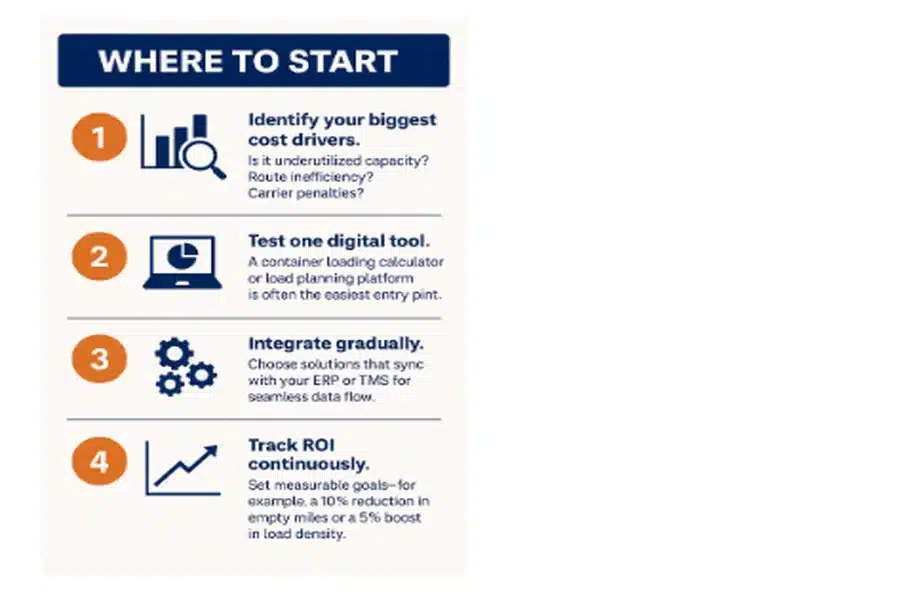
Where to Start
If you’re wondering how to reduce freight costs without overhauling your entire system, start small but strategic:
Companies that treat freight technology as a long-term investment, not an expense, see compounding returns year after year.
The Bottom Line
Freight cost control no longer depends on luck, gut feeling, or endless spreadsheet tweaking. Smart logistics tools, from AI forecasting to automated load planning, are giving businesses the clarity and precision they’ve always needed.
The takeaway is simple: efficiency pays. Every percentage point saved on shipping drops straight to the bottom line, improving profitability and sustainability in one move.
Technology doesn’t just reduce freight costs; it reshapes how supply chains compete, collaborate, and deliver.


