
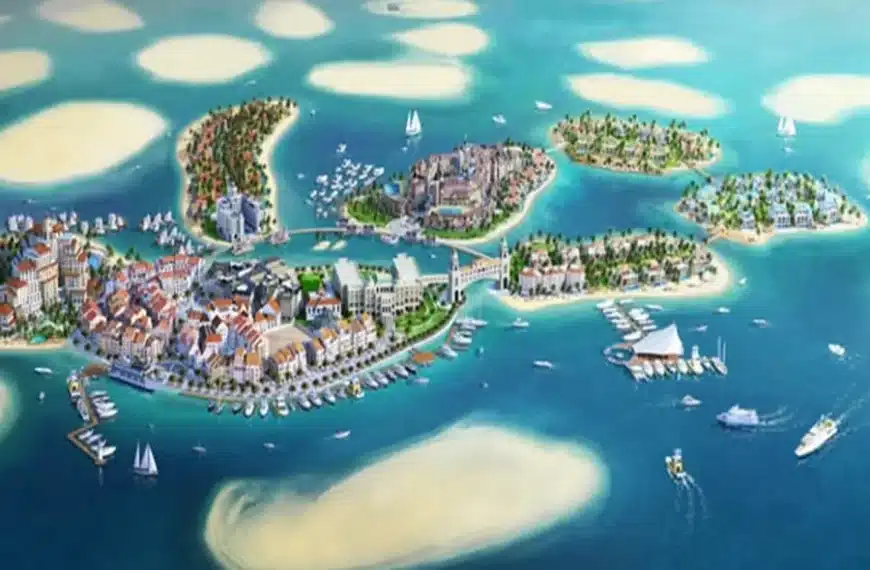
At the northern edge of Dubai, a new chapter in city-building is unfolding. The Dubai Islands project by Nakheel represents one of the most ambitious examples of engineering intelligence in the modern era. Built across five interconnected islands, it is not simply an expansion of the city’s coastline but a redefinition of how infrastructure, technology, and design can work together as a single living system. The project’s ambition goes beyond aesthetics; it aims to build a city that anticipates rather than reacts, that adapts in real time to its climate, its population, and its future.
Across this vast waterfront, developments such as Silena by Avenew, Ellington Cove, Bay Villas by Nakheel, Azizi Wasel and other projects are beginning to shape the physical and architectural identity of the islands. Each contributes a distinct layer to the overall composition — residential, cultural, and commercial — but all share a common foundation: systems thinking. The integration of smart infrastructure, renewable energy, and digital planning creates a blueprint for how coastal cities can evolve in the 21st century. It is not architecture as spectacle, but engineering as intelligence.
The Logic Beneath the Surface
While the visual appeal of Dubai Islands is clear — open boulevards, marinas, and water views — the real story lies underground and within the code. The master plan operates as a digital ecosystem, where every element is connected through sensors and automated systems. Roads, utilities, and drainage networks are embedded with data-gathering nodes that monitor temperature, usage, and movement. This information is continuously processed to optimise the city’s performance: energy is redirected, traffic is eased, water usage is reduced.
The design concept borrows from biological systems. Much like a living organism, the islands function through feedback loops. The built environment responds to external inputs — sunlight, wind, human activity — and adjusts accordingly. Artificial intelligence supports this process, ensuring the city remains energy-efficient, climate-conscious, and operationally balanced. In effect, Dubai Islands represent the shift from static master plans to adaptive urban frameworks.
Engineering for an Unpredictable Climate
Constructing a city in the Gulf demands a deep understanding of climate. High temperatures, humidity, and sea exposure place extreme pressure on infrastructure. Engineers for the Dubai Island project turned these challenges into opportunities for innovation. The islands’ design incorporates elevated land levels to mitigate flood risk and sea-level rise, while shoreline reinforcements use eco-engineered materials that stabilise soil and protect marine habitats.
Digital simulations play a central role in this approach. Before any construction began, thousands of environmental scenarios were modelled — from tidal variations to wind shear and heat accumulation. These virtual models guided decisions on orientation, materials, and drainage systems. By integrating climate data into the design process, engineers ensured the islands would not only survive environmental change but adapt to it. This marks a significant evolution in how Gulf cities are planned: science guiding style, resilience shaping form.
The Power of Predictive Infrastructure
At the core of Dubai Islands’ intelligence is predictive infrastructure — systems that sense, learn, and respond. Smart grids balance energy flow between residential, commercial, and public sectors. When demand rises in one zone, the system automatically compensates in another. Water networks detect leaks before they occur. Maintenance drones inspect structures using thermal imaging and send updates to a central control hub.
These processes are invisible to residents but transformative for sustainability. By automating basic urban functions, the islands reduce waste and increase reliability. In essence, technology becomes the city’s silent caretaker — one that allows human life to unfold naturally, without the friction of malfunction or inefficiency.
Integration of Digital Design
Digital tools shape not only how the city operates, but how it looks. The use of Building Information Modelling (BIM) and real-time simulation software allows architects and engineers to collaborate seamlessly. Every building, bridge, and utility line exists first as a digital twin — a complete, data-rich model used to predict energy use, wind flow, and material performance.
This technology bridges design and maintenance, ensuring that what is built today remains efficient tomorrow. It also enables flexibility: as needs change, models can be updated, and adjustments made without disruption. For Dubai Islands, this adaptability is essential. A project of this scale must evolve with technology itself. The result is a form of architecture that is not frozen in time but continuously recalibrated — living design supported by digital intelligence.
Sustainability Through Structure
Sustainability in Dubai Islands is embedded into the engineering logic rather than applied as an afterthought. The master plan includes renewable energy integration, water recycling systems, and shaded public spaces designed for passive cooling. But the most innovative aspect is how these systems work together.
Solar panels are positioned according to precise orientation data to maximise output and minimise reflection. Cooling systems reuse condensed water from air conditioning units to irrigate landscaping. Even road surfaces are engineered with reflective materials that reduce heat absorption. These measures not only lower the carbon footprint but redefine what “green architecture” means in a desert context — not cosmetic, but structural; not symbolic, but systemic.
Mobility Without Friction
Transport is often where cities fail, but Dubai Islands rethinks mobility as part of the living network. A combination of autonomous vehicles, electric buses, and pedestrian corridors ensures seamless movement across and between islands. Artificial intelligence manages traffic in real time, predicting congestion and redirecting flow.
Bridges and tunnels are embedded with smart sensors that monitor stress and adjust lighting or cooling as needed. Water transport adds another dimension: solar-powered ferries connect the islands and the mainland, providing both function and experience. The aim is to make movement effortless — a choreography of technology that feels invisible to those who benefit from it.
The Aesthetic of Precision
Beyond the data and algorithms, Dubai Islands also represents a visual statement about what a technologically intelligent city can look like. Its architecture reflects the precision of its systems — geometric, minimal, and balanced. Engineers and architects worked to create harmony between structure and sensation, where the logic of design becomes part of the city’s beauty.
Projects such as Silena by Avenew exemplify this intersection. Their façades are designed with parametric geometry, adjusting depth and angle to provide shade while maintaining aesthetic rhythm. It’s an approach where art emerges from function, and precision becomes the new ornament. In this sense, the islands’ identity is not futuristic for the sake of appearance, but for the sake of performance.
Human Experience in a Digital City
While Dubai Islands are a feat of engineering, their ultimate goal is human comfort. The project’s planners view technology not as an end but as a medium through which life can unfold more naturally. Public areas are equipped with responsive environments — lighting that softens at dusk, temperature-regulated seating, and soundscapes that adapt to crowd density.
This orchestration of sensory design turns technology into atmosphere. It creates a feeling of calm and order in a city defined by complexity. The digital disappears into the background, allowing the human experience to take the foreground. In doing so, Dubai Islands demonstrate that smart design is not about more technology, but about better living.
Engineering as a New Form of Culture
The Dubai Island is more than an infrastructure success; it’s a cultural one. It redefines what it means for a city to be modern — not in its size, but in its systems. The intelligence embedded in its bridges, utilities, and architecture represents a form of progress that aligns with global priorities: sustainability, adaptability, and balance.
For the engineers, planners, and designers involved, this is not just construction; it’s composition — the fusion of human creativity and digital precision. In this synthesis lies the real lesson of Dubai Islands: that the cities of tomorrow will be defined not by how high they rise, but by how intelligently they evolve.


