

Have you ever eaten a meal that made you feel tired while someone else felt fine after eating the same thing? Or noticed your energy changing during a stressful day, even though you had not changed what you ate?
These everyday differences can make you wonder what is happening inside your body and why your response may not match someone else's.
A continuous glucose monitor (CGM) offers another way to look at these changes by tracking glucose throughout your day. Instead of giving you one reading, it shows how glucose moves before and after meals, during stress, and around sleep or exercise. Over time, this can help you notice patterns that may be unique to you.
So, how does a tiny sensor turn these daily changes into useful information?
Let's take a closer look.
1. Enzyme Coating Turns Glucose into an Electrical Signal
Continuous glucose monitoring begins with a tiny sensor that sits just under your skin and measures glucose in the fluid around your cells. An enzyme on the sensor reacts with glucose and creates a small electrical signal. The amount of glucose detected affects the strength of that signal, giving the device information it can use.
The basic process is simple: glucose reaches the sensor, the enzyme reacts with it, and the device turns that reaction into data. This repeated process is what makes continuous glucose monitoring different from checking glucose only once. Instead of seeing one point in time, you can watch how your glucose changes throughout the day.
There is one important detail to remember, though: the sensor measures glucose in interstitial fluid, not directly from your blood. Because these readings can differ from blood glucose, especially when levels change quickly, a single number may not tell the whole story. Looking at overall patterns can give you more useful context.
2. A Transmitter Sends Glucose Data Every Few Minutes
After the sensor detects glucose, a small transmitter sends the information to a compatible reader, smartphone, or other display. Depending on the device, this information is collected at regular intervals throughout the day. That gives you a fuller view of your glucose changes than occasional testing can provide.
Imagine eating breakfast and watching what happens afterward. You might see your glucose rise and then settle, while another meal may create a different pattern. This can be interesting because your body's response to food may not always match what you expect.
The same process can show changes during other parts of your day. You might notice a different pattern after exercise, during a stressful morning, or following a late night. The CGM shows when changes happen, but it cannot automatically tell you exactly why they happened.
3. Algorithms Translate Sensor Readings into Glucose Levels
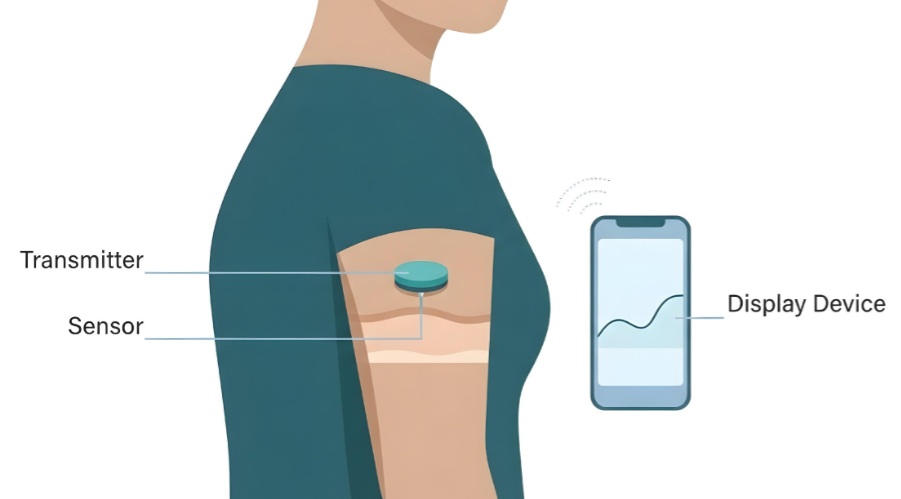
The electrical signal created by the sensor is not something you can read directly. Software processes that signal and turns it into an estimated glucose value that appears on your screen. Many systems also show whether your glucose is rising, falling, or staying fairly steady.
This matters because glucose can change at different speeds. Interstitial glucose can also lag behind blood glucose when levels move quickly, so the number on your screen is not always an instant picture of your blood glucose. Knowing this can help you avoid treating every reading as a precise measurement.
For people without diabetes, that context is especially important. A temporary rise after eating does not automatically mean a food is unhealthy, and a lower reading does not automatically mean you made a better choice. The more useful goal is to notice repeated patterns rather than judge yourself by individual numbers.
4. Continuous Sampling Captures Changes After Food and Stress
Because a CGM keeps collecting information, you can compare what happens after different meals, during stressful moments, after exercise, or following poor sleep. You may notice that your body responds differently to two meals that seem similar. This can give you a closer look at your own patterns.
For example, you might eat a meal containing carbohydrates and notice a rise afterward. On another day, you could eat something similar but take a walk afterward and see a different pattern. You might also notice glucose changes during a tense meeting or difficult afternoon, even without eating.
These observations can help you ask better questions about your daily habits. However, they should not make you feel like every glucose change needs to be controlled. Normal glucose movement is part of daily life, and nutritious foods can still cause temporary increases.
5. Timestamped Data Connects Glucose Changes to Possible Triggers
The information becomes more useful when you put it in a timeline. When you record your eating times, exercise, sleep or stress, you can compare these with the glucose changes recorded by your CGM. After several days, patterns may become easier to spot.
For instance, you might see a different glucose response following a bad night's sleep compared to a good night's sleep. You may also experience changes during a stressful time without having eaten recently. That does not mean that the change was caused by stress, but it is something to talk about or investigate.
With this approach, a CGM can be more than just a series of figures. It can assist you in visualizing the relationship between various parts of your day and glucose fluctuations. However, there is no research that has proven that routine CGM use benefits long-term health in individuals without diabetes; therefore, these readings should be interpreted as informational and not a diagnosis.
Conclusion
A CGM can give you a closer look at how your glucose changes throughout the day. By comparing those changes with meals, stress, sleep, and activity, you may notice patterns that are easy to miss when you rely only on how you feel.
That does not mean every change needs fixing, especially if you do not have diabetes. Use the information as a starting point for better questions about your habits and health, rather than as a scorecard. If something concerns you, a healthcare professional can help you understand what the pattern may mean.


