
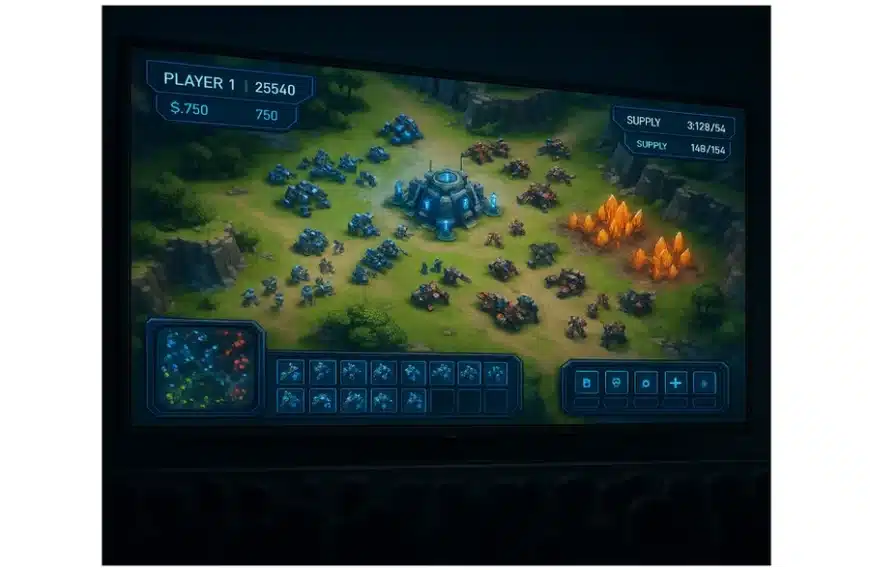
I’ve been watching AI development in strategy games for over a decade, and the current progress feels different from earlier attempts. Modern AI opponents don’t just follow scripted behaviors — they adapt, learn, and sometimes surprise even experienced players. Platforms like 1xbet Somali have started offering betting markets on player performance against standardized AI benchmarks, recognizing that these artificial opponents create measurable skill assessment opportunities.
The shift happened gradually, then suddenly. Early RTS AI was predictable: it would rush at specific timings, build in predetermined patterns, and fall apart when players deviated from expected strategies. Now we’re seeing AI that analyzes player behavior in real-time and adjusts its approach accordingly.
Machine Learning Approaches and Training Methodologies
Current AI development relies on reinforcement learning algorithms that allow systems to improve through repeated gameplay. DeepMind’s AlphaStar demonstrated this approach in StarCraft II, reaching Grandmaster level through self-play rather than programmed strategies.
Key development approaches include:
- Self-play training where AI systems compete against variations of themselves
- Imitation learning from human professional player replays and decision patterns
- Multi-agent training environments that simulate complex team-based scenarios
- Transfer learning that applies knowledge from one game to similar strategic contexts
- Adversarial training that specifically targets common human weaknesses and blind spots
The training process requires massive computational resources. AlphaStar trained for 200 years of game time (compressed into weeks through parallel processing) before reaching professional level. OpenAI Five used similar approaches for Dota 2, consuming thousands of GPU hours daily.
What’s interesting is how these systems develop strategies that human players hadn’t considered. They’ll make moves that seem suboptimal but create long-term advantages that become apparent only after hundreds of game steps. This has actually influenced human meta-game development.
The challenge isn’t just creating strong AI — it’s creating AI that provides meaningful practice for human improvement. An AI that wins through perfect micro-management doesn’t help players develop strategic thinking. The best training AI makes human-like mistakes while maintaining superhuman consistency in execution.
Standardized Testing and Performance Metrics
AI benchmarking systems have become important for measuring both AI capability and human skill development. These systems provide consistent baselines that don’t exist when humans only play against other humans.
Current testing frameworks measure reaction times, strategic decision-making, resource management efficiency, and adaptation speed. Players can track their improvement against AI opponents that don’t have bad days or inconsistent performance. This consistency makes skill assessment more reliable.
Professional teams now use AI training as a standard practice. They’ll identify specific weaknesses in their play and configure AI opponents to exploit those areas repeatedly. It’s like having a sparring partner that never gets tired and can focus on specific scenarios indefinitely.
The data collection possibilities are significant. Every decision, timing, and micro-action gets recorded and analyzed. Coaches can review exactly where strategic mistakes occurred and design training scenarios that target specific improvement areas.
Some organizations have developed AI difficulty scaling systems that gradually increase challenge levels as players improve. These systems track performance metrics and adjust AI behavior to maintain optimal learning conditions — challenging enough to promote growth but not so difficult as to be discouraging.
Competitive Integration and Future Development
AI opponents are becoming integrated into competitive gaming in unexpected ways. Some tournaments now include AI exhibition matches where professional players compete against cutting-edge systems. These matches serve multiple purposes: they showcase AI development progress and provide entertainment value for spectators.
Player training has been transformed by access to sophisticated AI opponents. Professional teams can practice specific scenarios repeatedly without requiring full team availability. A player can work on particular build orders or tactical responses at any time, with AI providing consistent opposition.
The development trajectory suggests we’ll see AI coaches before long — systems that analyze gameplay in real-time and provide strategic suggestions. Some experimental systems already offer post-game analysis with specific recommendations for improvement.
AI development is also pushing game design in new directions. Developers are creating scenarios and challenges that would be impossible with human opponents — perfectly synchronized multi-front attacks, frame-perfect timing execution, or strategic complexity that requires superhuman calculation speed.
The competitive scene is adapting to this reality. Some leagues are experimenting with human-AI hybrid teams, where human strategic oversight combines with AI tactical execution. Others are developing AI-only competitions that serve as testing grounds for new algorithms.
Training efficiency has improved dramatically. Players can now practice specific scenarios hundreds of times in a session, with AI providing consistent but varied responses. This focused practice approach accelerates skill development in ways that weren’t possible when practice required coordinating with other human players.
The long-term implications extend beyond gaming. These AI systems are developing strategic thinking capabilities that have applications in business, military planning, and other complex decision-making domains.


