
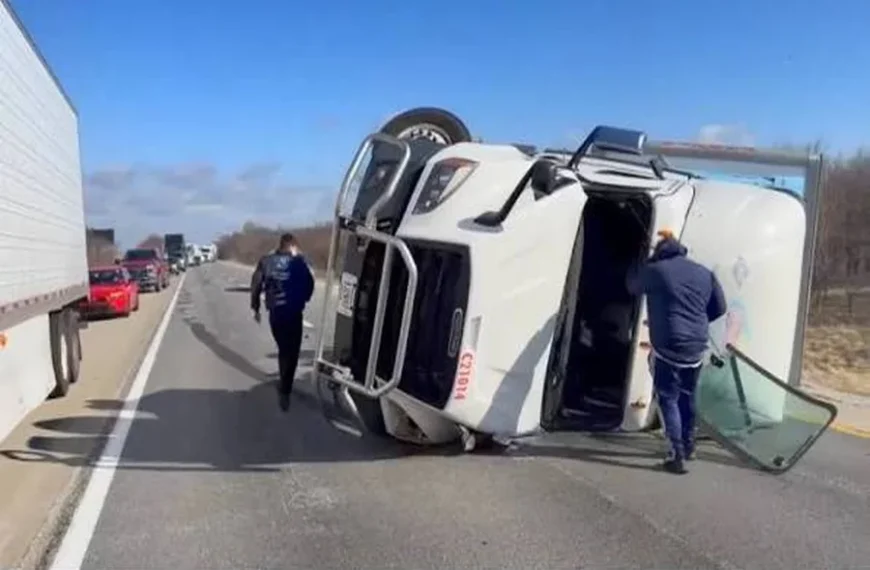
Anyone who’s ever driven in high winds knows that windy conditions can make driving more challenging and even more dangerous. But the risk of crosswinds is even greater for commercial trucks, for a variety of reasons. While any driver should exercise greater caution in heavy winds, these driving conditions are especially hazardous if you’re sharing the road with commercial trucks.
The Sail Effect
Let’s start with the biggest reason why commercial trucks are more vulnerable to crosswinds: Their enormous surface area catches more of the wind than smaller vehicles. This is often known as the “sail effect”, where the tall, wide trailer body acts as an impromptu sail, delivering a massive sideways force that can pull the truck to the side or even tip it in the most severe cases.
High Center of Gravity
To make matters worse, trucks also possess a higher center of gravity than most passenger vehicles. This is largely due to the trailer, which rides four to four and a half feet off the ground, well above the bottom of nearly all other vehicles on the road. As a result, a truck is more prone to tilting or tipping, and a strong crosswind can provide the force that stresses the truck’s high center of gravity.
Flexible Connection Between Cab and Trailer
Yet another risk factor is that a truck’s connection between the cab and the trailer is engineered to allow for slight side-to-side movement. This flexibility provides numerous benefits – Easier turning, better handling on uneven roads, a better distribution of weight when carrying heavy loads – But that ability to move becomes a liability in heavy winds.
When a crosswind applies horizontal force to the sail-like trailer, the flexibility in the joint between the cab and trailer pulls the trailer unevenly. This increases the risk of jackknifing or tipping, and makes handling the truck more difficult, even if the severity doesn’t rise to that level.
Factors Making Trucks Even More Vulnerable
The above three reasons explain the bulk of the reason why commercial trucks are so vulnerable to crosswinds, but there are some related factors that increase the risk even further. Being aware of these can help you evaluate the danger level and make intelligent decisions as your drive.
An Empty Trailer
A truck’s balance and stability come down to two main factors: the center of gravity and weight. A high center of gravity decreases stability, but a heavy enough weight provides a counterbalancing effect that increases stability.
When a truck’s trailer is empty, its vulnerability to crosswinds increases dramatically. Truck drivers are aware of this fact and will often take measures to reduce their risk when driving empty trailers in high winds. Often, you’ll see trucks pull over during the worst of a windstorm or reduce their speeds. But some truck drivers push the limit on this, and you’ll see trucks with empty trailers driving in unsafe high wind conditions.
As an observer, it’s possible to get a fairly good idea as to whether a nearby truck has an empty trailer. There are a few signs you can look for, including:
- An empty trailer rides noticeably higher than a fully loaded one. If you see a truck riding higher than other nearby trucks, it’s likely empty.
- Trucks have powerful suspensions capable of handling massive loads, and that suspension will tend to cause the trailer to bounce more when it’s empty.
- If you observe that a nearby truck is affected more by the wind than others around it, it’s likely empty. Unstable movements or increased sway due to the wind are the prime indicators.
If you see a truck that gives the appearance of being empty, exercise due caution, as that truck is significantly more likely to have a wind-related problem than trucks with full trailers, and the risk of a collision requiring a truck accident lawyer like the experienced attorneys at Thomas Law Offices is heightened.
Terrain Features Can Increase Risk Factor
Certain areas are more prone to high winds and sudden gusts, and commercial trucks are especially risky when traversing those types of terrain. Being mindful of your surroundings will help you anticipate those areas of increased danger.
Open plains and other areas with nothing to break up the wind’s power are prone to heavy winds. This includes most farmland, so a cross-country drive is likely to put you in long stretches of amplified wind risk zones.
Winds are often stronger at higher elevation, and that means that a truck’s risk factor will increase when passing over or through certain road structures. Overpasses and bridges often experience higher winds, as do mountain passes.
Finally, gaps between buildings or other large structures can channel winds, leading to powerful localized gusts that can seem to come out of nowhere as vehicles traverse that gap. These can be especially dangerous because the conditions might seem relatively calm before the gap, leading the truck driver to lower their guard and be caught unaware.
How to Protect Yourself
The first thing you can do to protect yourself on the road is to be vigilant. While high winds can be strong enough to be noticeable to a smaller vehicle, sometimes wind conditions can be in a between-point where low-profile cars aren’t affected, but commercial trucks are at risk.
Keep an eye on the trucks you’re driving around. Do any of them seem to be swaying or moving erratically? This can clue you in that wind may be an issue.
It’s important to understand that trucks have enormous blind spots, covering far more of their vicinity than passenger vehicles. A good rule of thumb is that if you can’t see the driver’s face through the window or a side mirror, the truck driver can’t see you.
If you fear that crosswinds might be affecting trucks, keep your distance. If you need to pass, do so quickly, but otherwise give the truck a wide berth, especially on the side. The last thing you want to do is ride next to the truck’s trailer for any length of time. The truck driver may not know you’re there, and high winds can cause the trailer to drift out of the lane into your space.
Commercial trucks are more vulnerable to crosswinds for a variety of reasons, from their huge surface area to their high center of gravity to their increased risk of swaying. Being aware of this danger and driving cautiously in high wind conditions will keep you and your passengers safe.


