
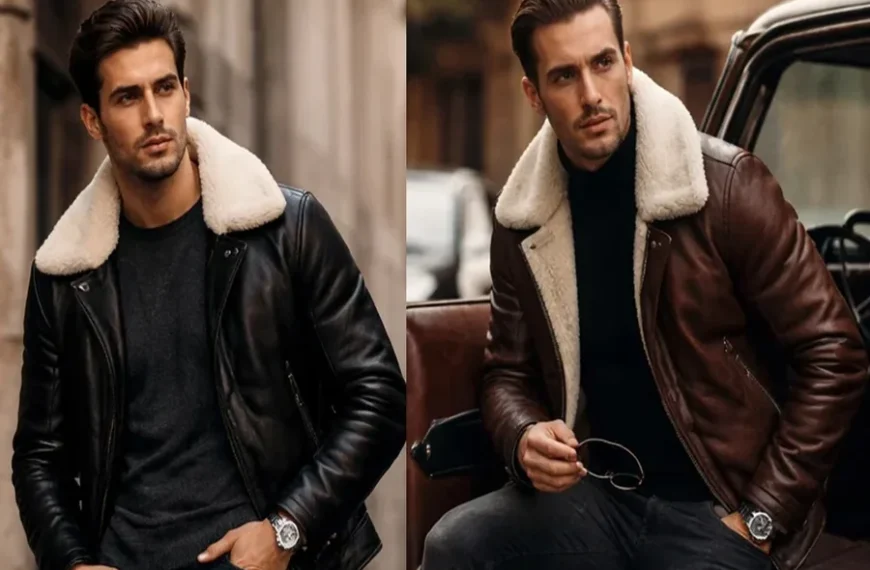
A sheepskin jacket and a puffer solve the same winter problem in different ways. Genuine sheepskin combines a wind-resistant leather exterior with natural wool insulation, making it warm, breathable, durable, and visually refined. A puffer uses down or synthetic fill to trap warm air, usually providing lower weight, easier packability, and stronger technical performance.
Neither is universally better. Sheepskin is particularly effective for cold, relatively dry weather, everyday city wear, and occasions where style matters. A quality down puffer normally delivers a better warmth-to-weight ratio, while a synthetic puffer is often more practical for damp weather and active outdoor use.
The right choice depends on climate, activity, construction, fit, and the type of insulation—not simply the name printed on the product page.
The Quick Verdict
Choose genuine sheepskin when you want:
- Natural wool insulation
- Strong wind resistance
- Better temperature regulation
- A structured, sophisticated appearance
- Everyday versatility
- A jacket capable of developing character with age
Choose a down puffer when you want:
- Maximum warmth with minimum weight
- Easy packing for travel
- High insulation in cold, relatively dry conditions
- A jacket for low-activity outdoor exposure
Choose a synthetic puffer when you want:
- Faster drying
- More dependable insulation in damp conditions
- Lower initial cost
- An active jacket for walking, hiking, commuting, or winter sports
These are starting recommendations rather than absolute rules. Jacket length, closures, insulation quantity, weather resistance, and fit can change the result significantly.
What Is a Genuine Sheepskin Jacket?
A genuine sheepskin or shearling jacket is made from sheep hide with the natural wool retained. The leather or suede surface forms the exterior, while the wool remains on the inside as insulation.
This is different from an ordinary leather jacket with a separate textile lining. Because the hide and wool remain part of one integrated material, a genuine sheepskin leather jacket provides insulation, structure, and exterior protection without relying on quilted chambers or loose filling.
The terms “sheepskin” and “shearling” are frequently used interchangeably, although product descriptions can vary. Buyers should always inspect the complete material specification rather than assuming that phrases such as “shearling style,” “shearling effect,” or “shearling lined” confirm genuine construction.
What Gives Sheepskin Its Warmth?
The natural crimp of wool creates small pockets that hold air close to the body. This trapped air helps reduce heat loss, while the fibers manage moisture vapor and support a more stable microclimate inside the garment.
According to Woolmark’s explanation of wool fibre, wool is naturally breathable and capable of absorbing moisture vapor before it condenses against the skin. This can help a wearer feel less clammy during normal movement or when transitioning between cold streets and heated indoor spaces.
The leather exterior also resists wind effectively. However, the complete jacket matters: air can still enter through an open collar, loose cuffs, short hem, unprotected zipper, or poorly constructed seams.
What Is a Puffer Jacket?
A puffer is an insulated jacket divided into stitched or bonded sections called baffles. These compartments hold down or synthetic insulation in place and create loft—the three-dimensional volume that traps warm air.
The familiar quilted appearance is therefore functional rather than purely decorative. A well-designed baffle system distributes insulation across the garment and reduces areas where warmth could escape.
Not every puffer performs the same way. The most important distinction is between down and synthetic insulation.
Down Puffers
Down is the fine insulating plumage found beneath the exterior feathers of ducks or geese. It is valued for its ability to create substantial loft while remaining light and compressible.
A well-constructed down jacket can provide an excellent warmth-to-weight ratio. It is particularly useful for cold, dry environments, travel, and situations where the wearer needs serious insulation without carrying a heavy garment.
Down has an important limitation: when it becomes saturated, the clusters can clump and lose loft, reducing their ability to trap warm air. Hydrophobic treatments may improve resistance to light moisture, but treated down should still not be treated as waterproof.
Synthetic Puffers
Synthetic insulation is generally made from fine polyester fibers designed to imitate some of the air-trapping properties of down. It is usually heavier and less compressible than comparable down, but it tends to dry faster and retain more insulating ability when damp.
This makes synthetic puffers useful for wet climates, active commuting, hiking, and other situations where rain, snow, humidity, or perspiration may be involved.
For a detailed explanation of these differences, REI’s comparison of down and synthetic insulation explains how fill type affects warmth, weight, drying time, compressibility, and wet-weather performance.
Sheepskin vs. Puffer at a Glance
| Feature | Genuine sheepskin | Down puffer | Synthetic puffer |
| Insulation | Natural wool retained on the hide | Natural down clusters | Manufactured insulating fibers |
| Raw warmth | High when wool is dense and coverage is complete | Potentially very high | Moderate to high |
| Warmth-to-weight | Good, but generally heavier | Usually the strongest | Lower than comparable down |
| Wind resistance | Strong when closures and seams are well designed | Depends on shell and construction | Depends on shell and construction |
| Damp-weather performance | Best protected from prolonged moisture | Loses performance when saturated | Retains more warmth when damp |
| Breathability | Naturally moisture-managing | Depends heavily on shell and design | Depends heavily on shell and design |
| Packability | Low | Excellent | Moderate |
| Drying speed | Slow if thoroughly wet | Slow when saturated | Usually faster |
| Durability | Potentially excellent with proper care | Varies by shell, baffles, and care | Varies by fibers, shell, and care |
| Maintenance | Specialist, finish-specific care | Careful washing and drying | Usually easier, but label dependent |
| Appearance | Structured, tactile, refined | Lightweight and technical | Sporty and practical |
| Best use | Cold, relatively dry everyday wear | Cold, dry weather and travel | Damp weather and active use |
Which Jacket Is Actually Warmer?
There is no responsible universal answer without comparing two specific garments.
A dense, full-coverage sheepskin jacket can be warmer than a thin fashion puffer. A substantial down parka can be warmer than a short shearling jacket. A synthetic puffer designed for active use may intentionally contain less insulation than either.
Actual warmth depends on:
- Wool depth and density
- Down fill power
- Total down fill weight
- Synthetic insulation type and weight
- Baffle design
- Jacket length
- Collar and hood coverage
- Cuff and hem construction
- Zipper protection
- Fit and layering room
- Wind, humidity, and precipitation
- The wearer’s activity level
Winter jackets generally do not share a standardized temperature-rating system. Any highly specific temperature promise should therefore be treated carefully unless the exact garment has undergone credible testing.
Understanding Fill Power
Fill power describes how much volume a given amount of down can occupy. Higher-quality down creates more loft for its weight, which can make a jacket lighter and more compressible.
Fill power does not reveal the jacket’s total warmth on its own. A lightweight jacket with a high fill power may contain less down than a heavier jacket with a lower fill power. To make a useful comparison, consider both fill power and fill weight, along with baffle design and body coverage.
The Importance of Garment Coverage
A longer jacket that protects the hips may feel substantially warmer than a cropped design made from the same material. A high collar, close-fitting cuffs, adjustable hem, and protected front zipper can reduce drafts and preserve more heat.
This is why material-only comparisons are incomplete. Warmth is produced by the complete garment.
Which Is Better in Cold, Dry Weather?
Both genuine sheepskin and down perform well in cold, dry conditions.
Sheepskin offers substantial natural insulation combined with a dense exterior that resists wind. It works particularly well for normal daily movement, commuting, outdoor dining, errands, and social occasions.
Down is preferable when minimum weight and maximum packability are priorities. A properly insulated down puffer can retain considerable heat without placing much weight on the shoulders, which is valuable for travel or extended outdoor use.
For low-activity situations, such as standing outdoors for long periods, the warmer garment will usually be the one with greater insulation, better coverage, and fewer openings—not necessarily the one made from a particular material.
Which Is Better in Rain, Snow, and Damp Weather?
Synthetic puffers generally have the clearest advantage when prolonged dampness is expected. Synthetic fibers retain more insulating performance when wet and normally dry faster than untreated down or saturated sheepskin.
Many puffers also use nylon or polyester shells with a durable water-repellent finish. That may help light rain or snow bead on the surface, but water resistance is not the same as waterproofing. Stitching, zippers, baffles, and untreated areas can still allow moisture to enter.
Sheepskin can usually tolerate brief contact with light moisture when the specific finish permits it, but it should not be treated as rainwear. Sustained exposure may darken, stiffen, stain, or distort the leather, while thoroughly wet wool can take considerable time to dry.
If a winter routinely involves persistent rain, wet snow, or slush, a technical waterproof shell or weatherproof insulated jacket may be more suitable than either an untreated sheepskin jacket or a standard puffer.
Which Provides Better Wind Protection?
Leather forms a dense exterior and can provide very effective resistance to cold wind. A high shearling collar can also protect the neck and lower face without requiring a separate scarf.
However, it is inaccurate to say that every leather jacket is automatically windproof. Performance depends on:
- Front-zip construction
- Storm flaps
- Seam design
- Collar closure
- Cuff fit
- Hem adjustment
- Jacket length
Puffers can also provide strong wind protection when made with tightly woven or laminated shell fabrics. Technical puffers may outperform poorly sealed leather jackets, while substantial aviator designs may feel more protective than lightweight fashion puffers.
The correct comparison is therefore jacket against jacket, not leather against fabric in isolation.
Breathability and Temperature Regulation
Sheepskin’s natural wool interior is one of its most useful advantages for everyday winter wear. Wool can manage moisture vapor and help moderate the environment inside the jacket. This is valuable when walking, driving, shopping, or moving repeatedly between outdoor cold and indoor heating.
Puffer breathability depends greatly on the shell, lining, insulation density, and ventilation features. A heavily insulated puffer can feel too warm on crowded transport or during brisk walking. A lighter technical puffer may manage active use much better.
Sheepskin can also become uncomfortably warm if it is oversized, exceptionally dense, or worn during intense activity. Breathability helps manage comfort, but it does not prevent overheating in every situation.
Weight, Bulk, and Packability
A traditional sheepskin jacket generally feels more substantial than a lightweight puffer. The weight comes from the complete hide, natural wool, reinforced seams, metal hardware, and structured construction.
Some wearers appreciate this reassuring feel. Others may find it tiring during long journeys or unsuitable for luggage with strict space limits.
Down is the strongest option for packability. Quality down can compress into a small space and recover its loft when released, provided it is stored and handled correctly. Synthetic puffers are usually bulkier than comparable down but still easier to pack than most sheepskin jackets.
Do not store any insulated jacket tightly compressed for extended periods. Sheepskin may develop creases or crushed wool, while repeated long-term compression can reduce the loft of some puffer insulation.
Mobility and Everyday Comfort
A jacket should allow the wearer to raise the arms, reach forward, drive, sit, and close the front without severe pulling across the shoulders or chest.
Sheepskin softens and adapts with wear, but a new jacket may initially feel more structured. A well-cut design should still provide functional movement from the beginning.
Puffers are often lighter and more flexible, making them useful for active travel and outdoor movement. However, extremely bulky baffles can interfere with arm movement, crowded transport, or layering beneath another shell.
The best mobility depends on pattern cutting and fit, not category alone.
Style and Versatility
Sheepskin has an advantage when a winter jacket must work across casual, smart-casual, and evening settings. Its combination of leather, natural wool, and structured shape gives it more visual authority than most technical outerwear.
For buyers drawn to a shorter heritage silhouette, a leather sheepskin aviator jacket combines natural wool insulation with a structured shape that works particularly well with denim, knitwear, tailored trousers, and winter boots.
Puffers are no longer limited to outdoor clothing. Minimal quilting, matte fabrics, neutral colors, and tailored proportions have made modern versions suitable for many city outfits. They still generally communicate a sportier or more technical character than genuine sheepskin.
The most versatile option is the one that fits both the weather and the wearer’s actual wardrobe.
Durability and Long-Term Value
A high-quality sheepskin jacket can provide many seasons of wear, but longevity should never be promised from the material name alone.
Important factors include:
- Hide quality
- Wool consistency
- Stitching and seam reinforcement
- Zipper and buckle quality
- Frequency of wear
- Exposure to moisture
- Cleaning methods
- Storage conditions
- Availability of specialist repair
Natural variation and gradual patina do not necessarily indicate damage. Cracking, peeling surface coatings, hardened leather, weak seams, and persistent moisture problems are more serious concerns.
Puffer durability also varies widely. A strong ripstop shell and well-secured baffles can last for years, while thin shells may tear or release insulation. Down can remain effective for a long time when it is cleaned and stored correctly. Synthetic insulation may gradually lose loft through repeated compression, but the rate depends on its quality and use.
A meaningful cost-per-wear calculation should use the jacket’s purchase price, realistic frequency of use, repairability, and expected service—not an invented universal lifespan.
Care and Storage
Caring for Sheepskin
Always follow the garment’s care label because smooth leather, suede, distressed finishes, dyes, and protective treatments respond differently.
General precautions include:
- Support the jacket on a broad or padded hanger
- Keep it away from direct sunlight and concentrated heat
- Use a breathable garment cover rather than airtight plastic
- Blot surface moisture gently instead of rubbing
- Allow a damp jacket to dry naturally at room temperature
- Test any cleaning product on a hidden area
- Use a specialist for deep stains or full cleaning
Avoid radiators, hairdryers, and other direct heat sources, which may stiffen or distort leather.
Caring for Puffers
Care requirements vary by shell and insulation. Follow the label rather than assuming every puffer is suitable for ordinary machine washing.
When washing is permitted, incorrect detergent, incomplete rinsing, or inadequate drying can reduce loft or create clumps. Down garments often require careful low-temperature drying and repeated gentle movement to restore loft.
Puffers should be stored clean, dry, and uncompressed.
How to Judge Quality Before Buying
Sheepskin Quality Checklist
Look for:
- Clear and specific material disclosure
- Dense, resilient wool
- Relatively consistent fleece coverage
- Supple leather without brittle areas
- Clean, reinforced seams
- Smooth zipper operation
- Secure buckles and adjustment straps
- Comfortable shoulders and arm mobility
- Accurate garment measurements
- Detailed care instructions
Small variations in grain, shade, or wool texture may be natural. Vague composition claims and unexplained synthetic panels deserve more attention than harmless natural variation.
Puffer Quality Checklist
Check:
- Down, synthetic, or hybrid insulation
- Fill power and fill weight where provided
- Baffle construction
- Even insulation distribution
- Shell strength
- Water-resistant treatment
- Secure stitching
- Cuff, collar, hood, and hem coverage
- Repair options
- Complete care instructions
A high specification in one area does not compensate for poor overall construction.
Which Jacket Is Right for Your Winter?
Choose Sheepskin If:
- Your winter is primarily cold and relatively dry
- You value wind resistance and natural insulation
- Your day involves casual and smart-casual settings
- You prefer a structured jacket
- You are comfortable with specialist care
- You want a distinctive long-term wardrobe piece
Choose a Down Puffer If:
- Warmth-to-weight is the main priority
- You travel frequently
- You need a highly compressible jacket
- Your conditions are mainly cold and dry
- You spend long periods outdoors at low activity levels
Choose a Synthetic Puffer If:
- Damp weather is common
- You generate perspiration through active use
- Faster drying matters
- You want simpler everyday maintenance
- You prioritize function and affordability over a formal appearance
Consider Owning Both If:
Your routine includes very different conditions. Sheepskin may serve as the refined daily jacket, while a puffer handles travel, heavy precipitation, outdoor activity, or unusually cold exposure.
Sustainability and Responsible Buying
No winter jacket becomes sustainable because of one material claim.
A more responsible purchase considers:
- How often the garment will be worn
- How long it is likely to remain useful
- Whether it can be repaired
- Material traceability
- Animal-welfare standards
- Tanning and chemical management
- Recycled content
- Washing requirements
- End-of-life options
Responsible Down Standard certification relates to traceability and animal-welfare requirements; it does not mean the product is vegan. Similarly, vegetable tanning, recycled leather, or recycled polyester should not automatically be interpreted as proof of low environmental impact.
The most defensible choice is usually a well-made jacket that suits the buyer’s real conditions, receives proper care, and will not be replaced unnecessarily.
Frequently Asked Questions
Is sheepskin warmer than a puffer jacket?
It can be warmer than a lightweight fashion puffer, but not necessarily warmer than a substantial down parka. The answer depends on wool density, puffer fill, total insulation, coverage, closures, weather, and activity level.
Is shearling the same as sheepskin?
The terms frequently overlap. Shearling generally refers to tanned sheepskin with the natural wool retained and trimmed. “Sheepskin” is broader and may require additional product information to confirm whether the fleece remains attached.
Is sheepskin warmer than down?
Dense sheepskin provides excellent insulation and wind resistance, but quality down normally offers a better warmth-to-weight ratio. Sheepskin provides more structure and everyday versatility, while down is lighter and more compressible.
Can sheepskin be worn in snow?
Brief exposure to light, dry snow may be manageable when the jacket’s finish and care guidance permit it. Prolonged exposure to wet snow can affect the leather and wool. Sheepskin should not be assumed to be waterproof.
Which puffer is better for wet weather?
Synthetic insulation is generally more dependable when damp and dries faster than untreated down. The shell construction and waterproofing remain important because no insulation performs at its best when thoroughly saturated.
Does higher fill power always mean a warmer jacket?
No. Fill power indicates the loft efficiency of down, not the total amount of insulation in the garment. Fill weight, baffles, coverage, and construction must also be considered.
Should a winter jacket fit tightly?
No. It should fit securely enough to limit excessive drafts but still allow the intended layers and natural movement. An overly tight jacket can compress insulation and restrict mobility.
Which jacket is better for commuting?
Sheepskin works well for moderate activity, wind exposure, and transitions between casual and smarter settings. A lightweight synthetic puffer may be more practical for active commuting or frequent wet weather.
Which is easier to travel with?
A down puffer is usually the easiest to pack because it offers high warmth with low weight and compresses efficiently. Sheepskin takes more luggage space and should not be tightly folded or compressed for long periods.
Which jacket lasts longer?
There is no fixed answer. Quality sheepskin is highly durable when correctly maintained, while a well-made down jacket can also remain useful for many years. Construction, wear, moisture, cleaning, repairs, and storage matter more than broad lifespan promises.
Final Verdict
Sheepskin is the stronger choice for buyers seeking natural insulation, wind resistance, breathability, durability, and a refined appearance in cold, relatively dry conditions. Down is usually superior when warmth-to-weight and packability matter most. Synthetic insulation is often the practical winner for damp climates and active winter use.
The best jacket is not simply the warmest one on paper. It is the garment that provides the right balance of insulation, weather protection, movement, maintenance, and style for the conditions in which it will actually be worn.
Compare complete garments, not marketing labels. Check the materials, insulation specifications, coverage, closures, fit, care requirements, and intended use. That approach leads to a more comfortable winter and a purchase that remains useful long after the season’s trends have changed.


