
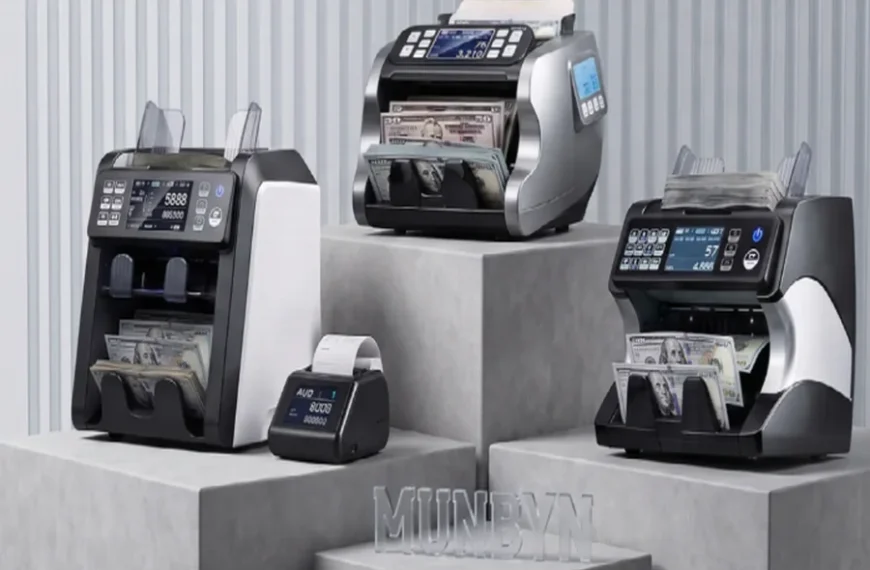
For businesses that handle cash every day, counting money is more than a routine administrative task. It affects checkout efficiency, end-of-day reconciliation, employee productivity, and the accuracy of financial records. As transaction volumes increase, manually counting banknotes can become time-consuming and leave more room for human error.
A money counter for business helps simplify this process by automatically counting banknotes, supporting cash verification, and reducing the time employees spend on repetitive tasks. For retail stores, restaurants, supermarkets, convenience stores, and other cash-intensive businesses, the right machine can make daily cash management more consistent and efficient.
However, not every business needs the same type of cash-counting equipment. Understanding the available features, counting modes, and security functions can help business owners choose a machine that fits their operations and budget.
Why Businesses Need a Money Counter
Although digital payments are increasingly common, cash remains an important payment method for many businesses. Cash transactions can accumulate quickly, particularly during busy periods, seasonal sales, and shift changes.
Manual counting may work for a small business with occasional cash transactions. However, as the volume of banknotes grows, the process becomes more demanding.
A commercial money counter can help businesses in several ways:
- Save time: Automate repetitive counting tasks during opening, closing, and shift changes.
- Improve counting consistency: Reduce mistakes associated with fatigue, distractions, and rushed manual calculations.
- Simplify reconciliation: Make it easier to compare physical cash with point-of-sale records and daily sales reports.
- Support employee productivity: Allow staff to spend less time counting and more time serving customers or handling other operational responsibilities.
- Strengthen cash-handling procedures: Standardize how employees count and verify banknotes.
For businesses with multiple employees handling cash, consistent counting procedures are especially important. A machine can help establish a repeatable process that is easier to train, monitor, and maintain.
What Types of Businesses Benefit Most from a Money Counter?
The value of a money-counting machine depends largely on how frequently a business handles cash and how much time it spends reconciling banknotes.
Retail Stores and Supermarkets
Retail businesses may process cash transactions throughout the day. At closing time, employees need to count cash drawers, prepare deposits, and compare totals against sales records.
A money counter can speed up these tasks and help managers process several cash drawers more efficiently. In stores with multiple checkout stations, the time saved can become significant over a full working week.
Restaurants and Cafés
Restaurants often handle cash from customer payments, tips, takeaway orders, and shift settlements. Managers may need to count banknotes several times a day.
A reliable counting machine helps standardize these routines, particularly when different employees manage the register across multiple shifts.
Convenience Stores and Gas Stations
Businesses that operate extended hours may have several cash handovers between employees. Faster counting can make shift changes more efficient and help staff complete cash reconciliation without unnecessarily delaying other duties.
Banks, Currency Exchanges, and Financial Service Businesses
Businesses that regularly process large quantities of banknotes may need more advanced features, including denomination recognition, counterfeit detection, and batch counting.
In these environments, the ability to process mixed denominations and identify potentially suspicious notes can be more valuable than counting speed alone.
Offices and Small Businesses
Small businesses that accept cash payments or prepare regular cash deposits may benefit from a compact machine with straightforward controls. The objective is not necessarily to purchase the most advanced equipment, but to reduce repetitive work and improve the consistency of cash handling.
How to Choose the Right Money Counter for Business
Before purchasing a machine, consider how your business handles banknotes, which currencies it accepts, and how employees will use the equipment.
1. Decide Whether You Need Basic or Mixed-Denomination Counting
One of the most important distinctions is the type of counting supported. A basic value-counting machine may require banknotes to be sorted by denomination before counting. It can be suitable for businesses that primarily process one denomination at a time.
A mixed-denomination money counter can identify different supported denominations in a single batch and calculate their combined monetary value. This can reduce preparation time and simplify cash reconciliation.
For example, an employee counting a cash drawer containing $1, $5, $10, and $20 bills would otherwise need to separate the notes, count each group, and calculate the total. A compatible mixed-denomination machine can automate much of that process. Businesses that frequently handle mixed cash drawers should prioritize this capability. Those with simpler counting needs may find a basic model sufficient.
2. Look Beyond Counting Speed
Manufacturers often advertise counting speeds in banknotes per minute. This specification matters, especially for businesses processing large volumes of cash. However, maximum speed is only one part of overall performance. Loading convenience, jam frequency, denomination recognition, and the number of manual steps required also affect productivity.
A machine that counts quickly but requires extensive sorting beforehand may not provide the greatest time savings for a busy store. Consider your typical workload and choose equipment that can handle peak periods without making everyday operation unnecessarily complicated.
3. Evaluate Counterfeit Detection Features
Counting banknotes and checking their authenticity are two different functions. Depending on the model, counterfeit-detection technologies may include ultraviolet (UV), magnetic (MG), infrared (IR), and contact image sensor (CIS) systems. These technologies examine different characteristics of banknotes to help identify potentially suspicious notes.
More detection methods do not automatically guarantee perfect results. Performance depends on the machine’s design, supported currencies, banknote condition, and detection settings.
Before purchasing, verify which currencies and denominations the machine supports and whether its detection functions meet your business requirements. Employees should also know how to handle rejected or flagged banknotes. Importantly, a detection alert should prompt further verification rather than be treated as definitive proof that a banknote is counterfeit.
4. Consider Displays and Ease of Use
Clear controls and readable displays make a difference when multiple employees share the same machine.
Look for an interface that makes it easy to select counting modes, review totals, and understand error messages. A customer-facing or secondary display can also improve visibility during cash verification. For businesses with frequent staff turnover, intuitive controls can shorten training time and reduce operating mistakes.
5. Check Batch Counting and Additional Functions
Batch counting allows users to count banknotes in predetermined quantities, which is useful when preparing cash bundles or organizing deposits. Add mode allows successive counts to be accumulated into a running total.
These functions are useful for different reasons:
- Batch mode: Helps prepare consistent groups of banknotes.
- Add mode: Combines multiple counting sessions into one total.
- Mixed-value mode: Calculates the value of supported denominations counted together.
- Reject handling: Helps separate banknotes that trigger detection or feeding alerts on compatible machines.
Choose the functions that address actual daily tasks rather than paying for features your team is unlikely to use.
A Practical Option: MUNBYN Money Counters
Businesses comparing equipment can explore the money counter machines available from MUNBYN. The range offers options for different cash-handling requirements, from routine banknote counting to more advanced mixed-denomination workflows.
For businesses that regularly process different denominations together, the MUNBYN IMC22 money counter for business is one model worth considering.
The IMC22 is designed for mixed-denomination and multi-currency counting, with a 3.5-inch TFT display and a separate customer display. Its advertised specifications include a counting speed of up to 1,200 banknotes per minute and a detection system that combines CIS, UV, MG, IR, and MT technologies.
These features can be useful for retailers, restaurants, and other businesses that want to streamline cash reconciliation while maintaining visibility into counting results. As with any machine, buyers should confirm currency compatibility, operating requirements, and the functions available for their intended use before purchasing.
Conclusion
Choosing a money counter for business is ultimately about matching equipment to operational needs. A small shop processing limited cash may need only basic counting functions, while a supermarket, restaurant group, or financial service business may benefit from mixed-denomination recognition, advanced detection, batch counting, and clear displays.
The right machine can help reduce repetitive work, support more consistent counting procedures, and make daily cash management easier to oversee. By focusing on practical requirements rather than specifications alone, businesses can choose equipment that supports both current operations and future growth.


