
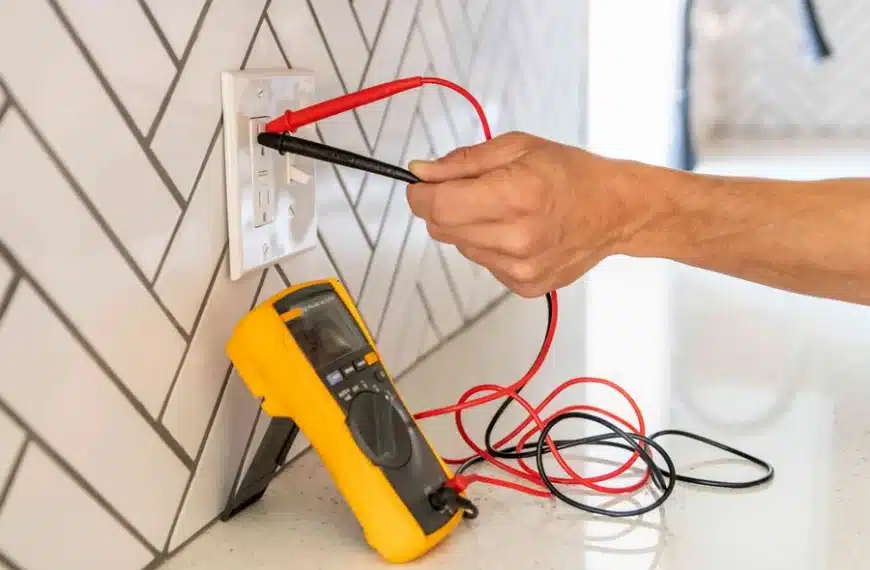
Testing voltage and continuity in your house is something you can do quite safely and accurately if you have the right equipment and know-how. It really doesn’t make a difference whether you want to check if a power point is live or locate the fault in a wire; you must use the correct method if you are to stay safe from electrical hazards and also not get incorrect results. These checks can be done by following the steps explained below, where safety is the first and foremost concern.
Choose the Right Multimeter and Safety Gear
Firstly, to perform this task, you will need a digital multimeter, which is a very common tool used not only for voltage measurement but also for continuity testing. Choosing a model that complies with appropriate safety standards and has voltage category ratings is very important; for home use, it would be best if it is CAT II or CAT III. Make sure to verify the fuse protection and input limits of the device at all times.
If you’re ever unsure about handling electrical tasks, it’s always wise to consult a professional. An experienced electrician can ensure that your home remains safe and compliant with local regulations. For those residing in Lansdowne, seeking the expertise of an electrician can provide peace of mind and prevent potential hazards. Whether you’re dealing with complex wiring issues or simply need advice on maintaining your electrical systems, reaching out to a trusted electrician in Lansdowne can make all the difference. They can offer valuable insights and services that go beyond basic testing, ensuring your home is both safe and efficient.
Professionals and serious DIYers often compare Fluke multimeter options for electrical testing because of their reliability, precision, and robust safety features. Whatever brand you choose, ensure the multimeter is in good working condition with no damaged leads or exposed wires.
Wear insulated gloves and stand on a dry, non-conductive surface. Use insulated tools, and if you can, have someone nearby for help if anything happens.
Test for Voltage on a Live Circuit
Before you begin any electrical work, it’s important to confirm whether a circuit is live. Here’s how to safely test voltage:
- Set the multimeter to AC voltage (V~) – Most home circuits run on alternating current. Use DC (V⎓) for batteries or low-voltage electronics.
- Insert the probes correctly – The black lead goes into the COM port, and the red lead into the voltage input port.
- Check on a known live source first – Prove that the multimeter is working by testing it on a socket or circuit you know is live.
- Test your target circuit – Place the black probe on the neutral or ground contact and the red probe on the live terminal. Keep fingers behind the insulated grip.
- Read the screen carefully – Household voltage in Australia should be close to 230V. An unexpected value could indicate a problem with the circuit.
Never let the metal parts of the probes touch each other during testing, and keep your hands clear of any conductive surfaces while taking measurements.
Test for Continuity on a Powered-Off Circuit
Continuity testing checks whether electricity can flow through a wire or component. It must only be performed on de-energised systems.
- Switch off power at the circuit breaker – Confirm with your multimeter (set to voltage mode) that no voltage is present.
- Set the multimeter to continuity mode – This is typically shown by a diode symbol or soundwave icon.
- Check your leads – Touch the probes together. A beep or near-zero reading confirms the tool is working correctly.
- Test your component – Place the probes on each end of the wire, fuse, or switch. A beep or low resistance reading indicates a closed circuit (i.e. continuous flow).
- Investigate faults – If there’s no tone or a high resistance reading, it may signal an open circuit fault due to a break or internal failure.
Typical uses include checking extension cords, verifying light switch terminals, or confirming appliance fuses are intact.
Know When Not to Proceed
Understanding when to refrain is equally important as knowing how to experiment. Doing simple voltage and continuity checks at a very basic level might allow you to identify very simple faults, but you really ought to stop your work straight away if you see any of the following: exposed wiring, burn marks around outlets or fittings, loose terminals inside a switchboard, or buzzing sockets and circuits that keep on tripping.
These are just some of the indicators that point to the serious electrical faults that cannot be safely fixed with only basic testing. Continuing to work in such conditions can cause the risk of electric shock and even fire, so you have to get a licensed electrician for these repairs and assessments.
Safe Testing Starts with the Right Approach
By taking these steps, homeownerscan safely and confidently carry out basic voltage and continuity tests. Never forget that electricity can be risky, and get good, quality tools that are designed for the job. If you are not sure, do not guess, check, isolate and ask a professional


