
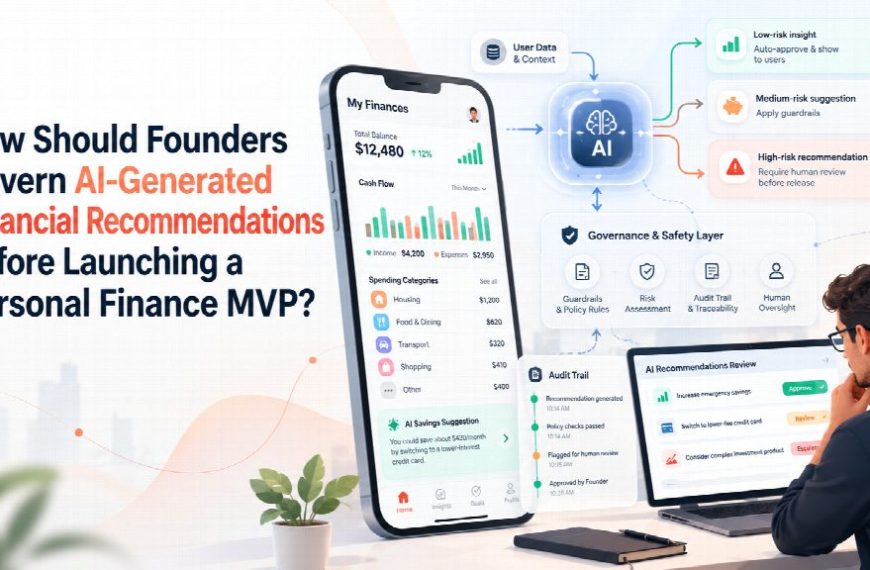
An AI-powered personal finance MVP can do more than just displaying transactions. It can categorize expenditures, spot changes in a user’s cash flow, suggest ways to reduce expenses, or tailor savings guidance to individual habits. These features can make a new product useful from the first release, without requiring a large team to handle every interaction manually.
The risk changes when those outputs can influence financial decisions. It can damage user trust and expose the product to regulatory and reputational concerns.
A more practical approach is to identify which risks need controls before users see the product and which can be monitored as usage grows. The AI-driven personal finance app guide will enable founders to know where the AI can act on its own, where the product needs to intervene, and what happens when the system does not have enough information to make a sound recommendation.
Start by Defining What the AI is Allowed to Recommend
The strongest way to approach governance at the MVP stage is to decide what the AI is allowed to do before deciding how the AI should do it.
A spending summary or transaction category usually presents less risk because it describes information the user has already provided or generated through their financial activity, while financial education can also exist in this lower-risk group when the product provides general information.
The level of scrutiny should increase when the AI starts making personalized suggestions. Recommendations involving investments, borrowing, debt repayment, or other decisions with significant financial consequences require greater care. A founder should consider whether the AI has enough relevant information to produce the recommendation, whether the output needs human review, and whether the product should refuse to provide an answer in certain situations.
This risk-based approach keeps the AI-driven personal finance app guide grounded in how the product will actually operate.
Build Human Oversight Into the Recommendation Flow
Human oversight does not mean putting every AI-generated recommendation in front of an employee before it reaches a user. That approach can slow an MVP to a crawl and still leave gaps. A better option is to decide where a person, an additional check, or a fallback should enter the recommendation flow based on the potential impact of the output.
The product also needs a clear response for situations where the AI does not have enough information. Rather than filling the gap with a confident guess, the system can decline to make the recommendation, explain what information is missing, or direct the user to another form of support.
Founders should also make the recommendation process traceable, and that same visibility should continue after launch. Teams can monitor for unusual recommendation patterns, such as a sudden increase in debt-related suggestions or outputs that fall outside the product’s intended scope. These signals can help identify problems before they affect a larger group of users.
Test the Failure Cases Before Testing the Launch Case
Consider a user whose bank data is several days old. The AI may suggest cutting back on a category without knowing that a large payment has already left the account. Another user may have conflicting income information across connected accounts. A sudden spending spike may also look like a pattern that needs intervention when it is simply a one-time expense. These cases can change the meaning of a recommendation without changing the model itself.
Testing should therefore cover the full recommendation flow, from data entering the system to the final output shown to the user.
For founders without a large internal AI engineering or governance team, the development partner can also shape how these controls are built into the MVP from the start. That makes the choice of an engineering partner relevant to the product’s risk, not simply its development speed.
5 US-Based Product Engineering Companies to Consider for AI-Powered Finance MVPs
The following US-based companies offer services that can support different parts of that AI-powered finance MVPs development process.
1. GeekyAnts
GeekyAnts is an AI-Powered Digital Product Engineering & Consulting Company. Their capabilities span AI product engineering, AI agents, application development, cloud, DevOps, testing, and security. Their range of services is relevant for building personal finance MVPs where the AI recommendation is only one part of a larger product that also needs data flows, user interfaces, testing, and defined decision points around AI outputs. For a finance MVP, their broader engineering scope can enable recommendation controls to be connected with the rest of the product.
Clutch Rating: 4.9 (120 reviews)
Address: GeekyAnts Inc., 315 Montgomery Street, 9th and 10th floors, San Francisco, CA 94104, USA
Phone: +1 845 534 6825, Email: info@geekyants.com, Website: www.geekyants.com/en-us
2. Red Hawk Technologies
Red Hawk Technologies provides custom software development, mobile application development, systems integration, and AI development. Their work can be relevant to a personal finance MVP that needs AI capabilities to operate within a mobile or web application rather than as a separate experiment. The company also works on software product support and code evaluation, which can help when an MVP needs to connect with existing applications or undergo technical review as new features are introduced.
Clutch Rating: 4.8 (15 reviews)
Address: 1 Moock Road, Building A, Suite 202, Wilder, KY 41071, USA
Phone: +1 859 360 5583
3. Wakefly, Inc.
Wakefly, Inc. provides custom software development and web development, with experience building and modernizing digital platforms. Their services can be relevant to a personal finance MVP where the AI capability needs to sit within a customer-facing web experience. For example, an MVP may need the recommendation interface, application logic, integrations, and supporting systems to work together before founders can assess how users interact with the feature.
Clutch Rating: 4.8 (24 reviews)
Address: 290 Turnpike Road, Suite 5-332, Westborough, MA 01581, USA
Phone: +1 508-616-2042
4. CodeBranch
CodeBranch provides custom software development, AI development, mobile applications, and other engineering services. Their AI and software development capabilities can fit an MVP where recommendation features need application engineering, testing, security, and defined product requirements around them. This can be useful when founders need to test the complete product workflow rather than evaluate an AI model in isolation.
Clutch Rating: 4.8 (11 reviews)
Address: CodeBranch LLC, Delaware, USA; delivery office: Carrera 63B 32E–115, Medellín, Antioquia, Colombia
Phone: +1 917 271 7451
5. Sonatafy Technology
Sonatafy Technology provides custom software development, mobile application development, application modernization, and software engineering services. Their services can support the application work surrounding an AI feature, including development, modernization, testing, and integration with an existing technology environment, and are relevant to companies that need additional product engineering capacity for an AI-enabled MVP.
Clutch Rating: 4.8 (25 reviews)
Address: 14362 N. Frank Lloyd Wright Blvd., Suite 1000, Scottsdale, AZ 85260, USA
Phone: +1 (602) 740-9866
Conclusion
AI can make a personal finance product useful from its first release, but financial recommendations deserve more care than ordinary AI-generated content. A budgeting suggestion, debt-related prompt, or savings recommendation can influence what a person does with their money, so founders need to define those boundaries before the product reaches users.
As the product gains users and begins handling more consequential decisions, its governance should evolve with it. The goal is not a risk-free MVP. It is a product where the important risks are visible, bounded, and manageable.


