
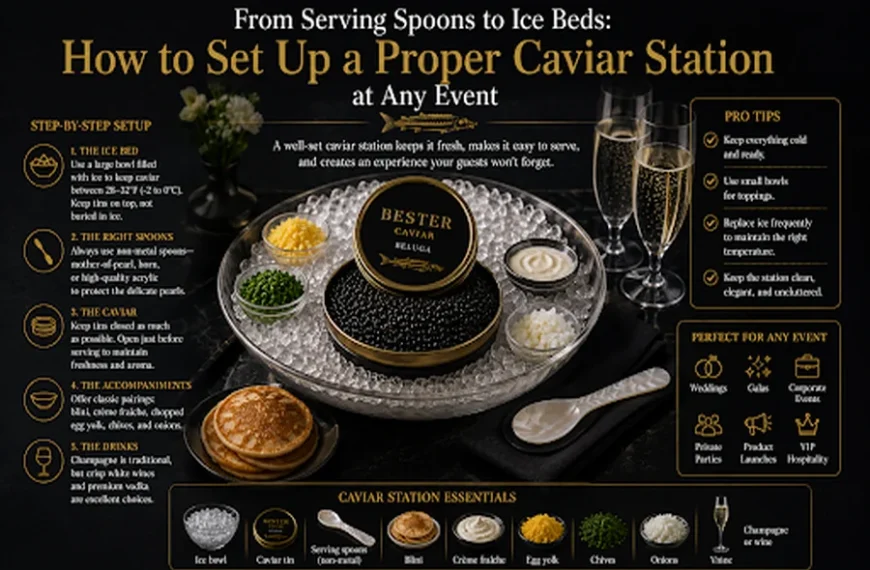
A caviar station looks simple. Tin on ice, spoons on the side, maybe some blinis nearby. But most first-time hosts who put one together at an event end up with caviar that’s too warm by the second hour, spoons that leave a metallic taste, and no clear sense of how much to order. The planning starts well before anyone arrives, and so does the sourcing. If you want to buy caviar online at Bester Caviar, they ship non-pasteurized sturgeon roe overnight anywhere in the US, which takes the supply question off the table. The setup question is what this guide covers.
Here’s how to do it right, from the ice bed up.
Start With Temperature: Everything Else Depends on It
Fresh non-pasteurized caviar needs to stay between 23 and 34 degrees Fahrenheit from the moment you take it out of the fridge until the last spoonful is served. That’s a narrow window, and it matters more than most hosts expect. At 40 degrees, the pearls start to soften. At 50, the flavor changes noticeably. At room temperature, you’ve wasted a significant amount of money on something that no longer tastes the way it should.
Everything else about setting up a caviar station, the containers, the spoons, the accompaniments, is secondary to this one requirement. Get the temperature right and you have time to work with. Let it slip and no amount of beautiful presentation fixes what happens to the roe.
For a short event, two hours or less, a good ice bed under the tin is enough if you manage it properly. For anything longer, you need a plan to refresh the ice at least once, or a more insulated setup that holds temperature passively. I’ll get to the specifics of building that ice bed in a moment.
The Spoons: What to Use and How Many You Need
Metal spoons are not an option. Stainless steel, silver, gold-plated, doesn’t matter: any metal reacts with the oils in the roe and leaves a metallic aftertaste that guests will notice even if they can’t identify the source. The spoon is the one piece of equipment where there’s no acceptable workaround.
Mother of pearl spoons for caviar are the standard choice for a reason. They’re chemically neutral, smooth enough not to break the pearls on contact, and they look appropriate at a formal or semi-formal event. A set of six runs $20 to $60 depending on quality, and they’re reusable indefinitely if you hand-wash them rather than putting them through a dishwasher. Bone spoons work equally well. A good quality non-reactive plastic spoon is fine for casual events where the aesthetic matters less.
For quantity: at a standing event where guests serve themselves, plan for at least one spoon per tin, ideally two so there’s always a clean one available while the other is being used. For a seated caviar course, one spoon per two guests is typically enough if service is managed. At a large buffet-style station with constant traffic, have more than you think you need. Running out of clean spoons mid-service is the kind of thing that looks disorganized in a way that’s hard to recover from.
How to Build an Ice Bed That Actually Holds Temperature
The standard approach, a bowl of ice with the tin sitting on top, works but not for long. Ice melts, the water pools under the tin, and within 45 minutes at room temperature you’ve lost most of the temperature benefit. There’s a better way to do it.
Use crushed ice rather than cubed. It packs more densely around the tin and makes contact with more surface area, which means slower temperature loss. Put the ice in a container deep enough that the tin sits in the ice rather than on top of it, ideally with ice on the sides as well as underneath. A proper caviar holder, which is a double-walled vessel designed to keep ice contained and the tin stable, extends your window significantly compared to a standard bowl. Most good caviar holders will keep a tin at serving temperature for 90 minutes to two hours without refreshing the ice.
For longer events, assign someone to check and refresh the ice every hour. This is easy to forget when you’re hosting, which is why it helps to write it into the event timeline explicitly rather than relying on memory.
What to Put Around the Caviar (And What to Leave Off the Table)
Less is more. The accompaniments at a caviar station are there to give guests something to put the caviar on, not to create a spread that competes with the roe for attention.
The essentials: warm blinis, crème fraîche or sour cream, and plain toast points or water crackers. Those three cover the classic caviar service format and work with every variety. If you want to add something more interesting, finely chopped chives and sieved hard boiled egg yolk are both good additions that stay out of the way flavor-wise.
What to leave off: anything smoked, anything strongly flavored, anything pickled. Smoked salmon next to caviar is a common mistake at events because it looks natural together. In practice both ingredients are intensely salty in different registers and they mute each other. Same problem with strong cheeses or anything with significant acidity. Keep the table simple and the caviar stays the point.
Calculating How Much Caviar to Order Per Guest
This is where most first-time hosts either over-order dramatically or run out embarrassingly early. The numbers depend on how caviar is being served and at what point in the event.
As a passed appetizer at a cocktail reception, 5 to 8 grams per person is a reasonable estimate. As a dedicated caviar station where guests return multiple times over the course of an evening, 15 to 20 grams per person gets you through most events without running short. As a formal first course with table service, 20 to 30 grams per person is the restaurant standard.
When in doubt, order slightly more than you think you need. Leftover caviar, stored properly and unopened, keeps for several weeks. An empty tin with guests still at the table is a much harder problem to solve.
The Mistakes Most First-Time Hosts Make
Opening all the tins at once is probably the most common one. Once a tin is opened, the clock starts. Caviar is best within the first 30 to 45 minutes after opening, and quality declines noticeably after two hours even if it’s kept cold. Open one tin at a time and keep the rest sealed in the fridge until needed.
Letting the ice melt and not replacing it comes second. Set a timer. Check the ice at the one-hour mark regardless of how busy things are. The cost of a few minutes of attention is much lower than the cost of serving warm caviar to guests who paid for a premium experience.
Putting out too many accompaniments is another one. A table with twelve small bowls of garnishes looks chaotic and makes guests unsure what the correct bite is supposed to be. Three accompaniments, maximum. The simplicity is the point.
Finally, skipping the spoon audit before the event starts. Check that every spoon at the station is non-metal before guests arrive. Metal serving spoons get mixed in more often than you’d expect at catered events, and by the time someone notices the off taste it’s already affected several servings.
If you need spoons, a caviar holder, blinis, or other supplies for your event, the full range of caviar accessories is available at Bester Caviar alongside the roe itself, so you can sort out the whole setup in one order.


