
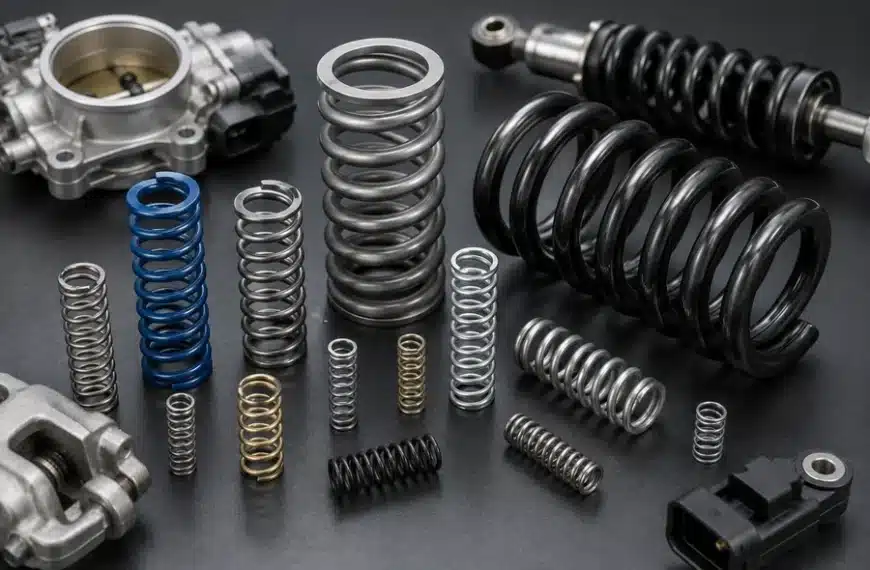
Hagens is a compression spring manufacturer supplying both standard and custom compression springs with wire diameters ranging from 0.1 mm to 25.00 mm. Their range covers precision applications as well as heavy-duty industrial and automotive requirements, with surface treatment options including galvanizing and painting.
- Wire diameter range directly determines whether a spring can handle precision automotive sensors or heavy-duty suspension and drivetrain loads. Selecting the wrong range leads to early fatigue or dimensional misfit.
- Standard compression springs cover the majority of automotive component applications, but non-standard bore sizes, load curves, or harsh environment requirements typically call for a custom-designed solution.
- Surface treatment is not cosmetic. Galvanizing or painting affects corrosion resistance and fatigue life in automotive environments where springs are exposed to moisture, salt, or mechanical cycling.
Wire Diameter and Load Type in Automotive Springs
Wire diameter is the single most consequential variable when specifying a compression spring for an automotive part. A 0.1 mm wire spring engineered for a fuel injector valve has almost nothing in common with a 20 mm wire spring inside a commercial vehicle suspension assembly. Failure modes change, and tolerances shift from microns of deflection accuracy to kilonewtons of load capacity.
Hagens, as one of the established compression spring manufacturers covering the full 0.1 mm to 25.00 mm wire diameter range, provides a useful reference for mapping applications to spring categories. A spring cycling thousands of times per minute in an ABS modulator requires far tighter control than one holding a constant preload on a sensor contact.
- 0.1 mm to 1.0 mm wire: sensor contacts, micro-valves, small electronic actuators inside ECUs and dashboard assemblies
- 1.0 mm to 5.0 mm wire: throttle return springs, fuel system regulators, brake caliper return mechanisms, HVAC blend door actuators
- 5.0 mm to 12.0 mm wire: clutch assist springs, gearbox detent springs, mid-range suspension components for passenger vehicles
- 12.0 mm to 25.0 mm wire: primary suspension springs, heavy-duty drivetrain dampers, commercial vehicle load-bearing applications
Standard Springs vs Custom Springs for Automotive Grade
Most automotive component manufacturers start with catalogue springs — available quickly, priced competitively, and manufactured to established tolerances that work for a wide range of applications.
Automotive-grade requirements have a way of pushing past what standard springs can deliver. A bore diameter 0.5 mm smaller than the nearest catalogue option. A load curve that needs to stay within 3% across the full deflection range. A material specification driven by an OEM’s internal corrosion test protocol. These are the situations where custom springs become a practical requirement rather than a luxury.
Load curve accuracy in standard springs typically holds within 10 to 15% of the nominal rate — fine for mounting brackets and cover retention. For valve return or pressure regulation applications where load tolerance sits at 3 to 5%, custom springs with tighter manufacturing controls are the realistic path forward.
Material specification in standard catalogue ranges usually means music wire or basic stainless steel. Automotive OEMs increasingly specify particular alloy grades, hydrogen embrittlement testing, or mill-traceable certifications — requirements that custom springs accommodate because the material is selected for the application.
Surface treatment on standard springs tends to be limited to zinc plating or none. Custom specifications allow treatment matched to the actual operating environment, whether hot-dip galvanizing for underbody exposure or painted finishes for colour-coded assembly identification.
Material Selection Affects Fatigue Life
Carbon steel, stainless steel, and alloy steel each behave differently under repeated cycling — and a spring in automotive service may see millions of load cycles over the vehicle’s life.
Carbon steel offers good fatigue resistance at lower cost but corrodes without surface protection. Stainless steel resists corrosion natively, yet certain grades sacrifice fatigue strength compared to high-carbon alternatives. Alloy steels like chrome vanadium or chrome silicon provide the best combination of fatigue life and high-temperature stability for demanding dynamic applications. Getting this choice wrong shortens spring life by 40 to 60% in high-cycle automotive applications.
Surface Treatment and Automotive Environments
A spring that performs perfectly on the test bench can fail within two years if its surface treatment does not match the installation environment.
Galvanizing provides a zinc barrier layer that sacrificially protects base steel from moisture and salt spray — common threats for springs in the underbody, wheel well, or engine bay. Painting adds a polymer barrier and allows colour coding for assembly line identification. Hagens offers both, giving automotive manufacturers flexibility to match protection level to actual exposure conditions.
When to Specify Hagens Custom Springs
If a standard spring fits the bore, meets the load tolerance, uses an acceptable material, and survives the target environment, there is no reason to go custom.
When any one of those four criteria falls outside standard parameters, compression spring manufacturers with custom capabilities become the practical next step. Non-standard free lengths, unusual solid height constraints, specific load curves tied to OEM validation requirements, or combined environmental and fatigue demands that no catalogue spring satisfies — these are the triggers. Manufacturers can initiate that process through Hagens custom springs, where projects move from concept to production based on real engineering constraints rather than catalogue limitations.


