
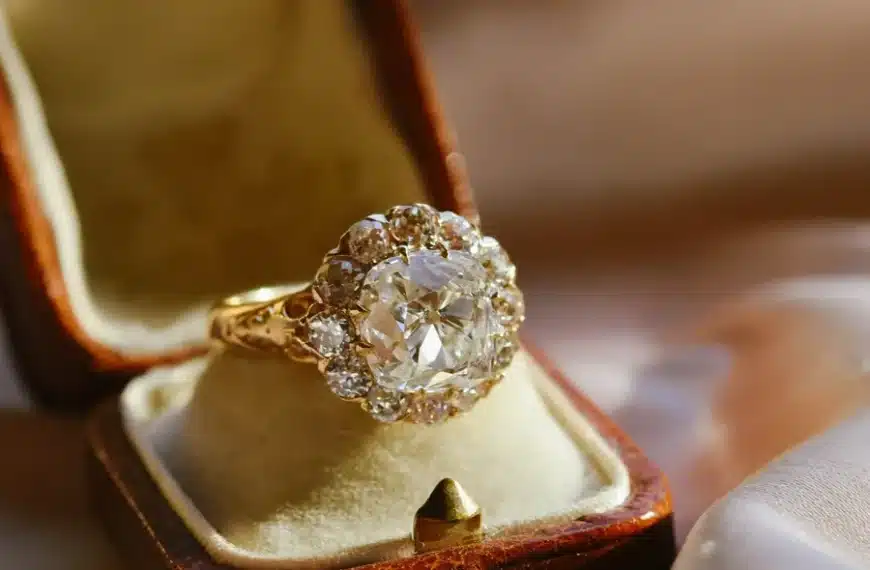
Staring at a jeweled circle of metal, it’s strange to conceptualize the history behind engagement rings. The ancient tradition has spanned centuries; billions of recipients, billions of creators, and billions of proposals. These rings are a symbol of commitment, but have also undergone multiple evolutions in their own right.
Understanding 20th-century heritage is a sweet way to emphasize tradition in a proposal. What did women wear before the supersized engagement rings trending right now? Are there designs that could inspire vintage bling for that “commitment finger?” Here’s the evolution of engagement rings, from the 1950s to today.
1. 1950s–1960s: The Era of Classic Diamonds and Glamour
There is an assumption that diamonds have always been the stone of choice. Yet, the stone’s popularity really solidified in the post-WWII period. In 1947, De Beers released the slogan “a diamond is forever,” which, coupled with the soaring economy and reunited or fresh couples, sparked a boom in solitaires.
Simple motifs ruled the engagement trends. An elegant solitaire engagement ring was the epitome of tradition and timelessness. Clearly, the predictions were correct, as the design remains classic today.
2. 1970s–1990s: Experimentation, New Cuts, and Statement Styles
By 1971, Shirley Bassey was singing “diamonds are forever,” and the obsession had taken hold. There was an increase in experimentation, though. With diamonds as the go-to stone, individuality now came from cuts and styles.
The squared “princess cut” was in hot demand, while expressive settings and abstract cluster rings were on the rise. Fashion was beginning to create new avenues for personal expression, even with traditional symbols like engagement diamonds.
3. 2000s–2010s: The Rise of Halo Settings, Mixed Metals, and Customization
Welcome to a new century. Diamonds were still the stone of the moment, but the trend towards uniqueness was continuing. Forget simply choosing a cut, though; from 2000 to 2010, the focus was on settings.
There was a boom in pavé designs, where metal bands are studded with smaller stones, and halo rings, with stones surrounded by smaller stones. People began organizing their diamonds differently. Similarly, the early 2000s brought experimentation with metals: jewelers now dabbled in white, platinum, and rose gold.
4. 2020s to Today: Personalization, Ethical Choices, and Bold New Trends
As of 2020, there has been another shift entirely. The engagement trends we’ve seen everywhere in 2025 include sustainability and color. Engagement rings are increasingly lab-grown for ethical reasons and boldly personalized with strikingly bright gemstones.
Inspiration is now a melting pot of heritage-inspired choices. Those couples who saved for diamonds in the 50s, dreamed of distinct cuts in the 70s, and mixed metals in the early 2000s, paved the way for an era of personalization. And, with social media, we’re never short of celebrity inspiration.
Each engagement ring tells a story and carries a history. What design will you choose for your partner?


