
Most marketing organizations are not short on campaigns. Acquisition programs, product launches, promotions, nurture streams, renewal communications, and re-engagement journeys are all running at the same time.
The platforms behind them are sophisticated too: Salesforce Marketing Cloud, Braze, HubSpot, CDPs, data warehouses, analytics tools, and more recently, AI capabilities. And still, the lifecycle programs built on top of all this often feel disconnected.
Our view is that technology is rarely the problem. The gap usually sits somewhere else: customer data, behavioral events, segmentation, decisioning, orchestration, and measurement are not working as one connected system. That is the real job of lifecycle marketing.
Lifecycle marketing is a customer-centric approach to engagement. It uses a customer’s state, behavior, intent, and history to decide what experience should happen next. Instead of treating every email, push notification, SMS, or campaign as an isolated interaction, it connects them into one continuous customer experience. The clearest difference is where each approach begins.
Lifecycle marketing starts with customer state
Campaign marketing usually starts with an objective. The business has a promotion, a launch, an announcement, or a content asset. The team defines an audience, picks the channels, and measures the response. Lifecycle marketing starts from a different place: customer state.
Customer state means knowing where the customer stands in their relationship with the business, what they have done recently and what they haven’t, which products or services they use, which signals point to intent, engagement, risk, or opportunity, and what communication they have already received. A campaign calendar cannot answer any of that. It takes an underlying customer model that the engagement systems can actually read and act on.
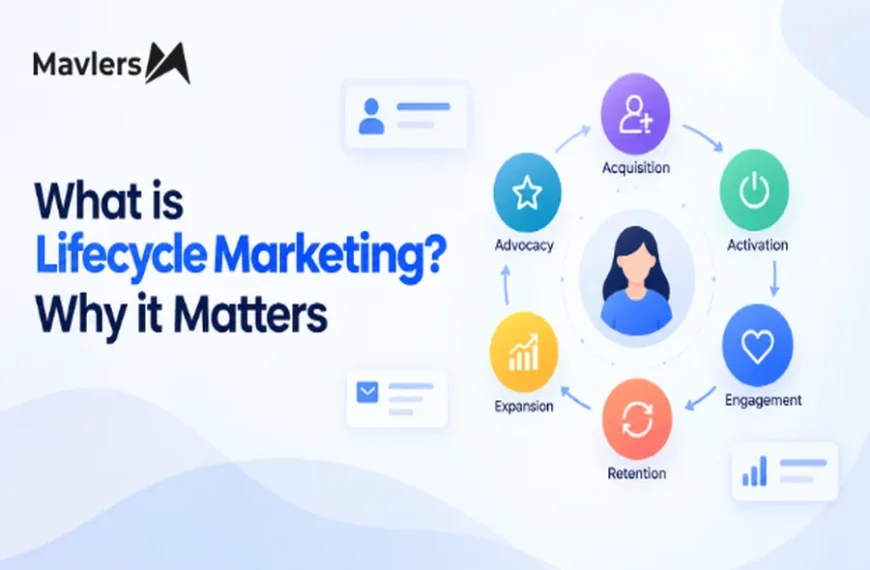
A useful lifecycle model might include acquisition, activation, engagement, retention, expansion, and advocacy, though the stages will vary from one business to another. The bigger point is that they are not rigid steps. A customer can be highly engaged and still show churn risk soon after. Another can move from one product to another, or turn into an expansion opportunity, without following any predictable sequence. We find it more useful to see the lifecycle as a changing customer state rather than a fixed funnel.
Campaigns still have a place in this picture. The comparison below shows what changes around them.
Lifecycle Marketing vs. Campaign Marketing
Campaigns remain an important part of lifecycle marketing. What changes is everything around them. A campaign usually comes with a defined audience, an objective, a start date, and an end date. Lifecycle marketing looks wider. It considers what happens before the campaign, how customer behavior affects eligibility, what else the customer is receiving, and what should happen once the interaction is over.
| Campaign Marketing | Lifecycle Marketing |
| Starts with a campaign objective | Starts with customer context |
| Audience is usually defined upfront | Audience evolves with behavior |
| Often organized around launches or promotions | Organized around customer state and signals |
| Optimizes individual campaign performance | Optimizes customer and business outcomes |
Take a major seasonal promotion sent to a broad retail audience. The lifecycle layer decides how that promotion behaves for each customer. It suppresses customers who have already purchased, prioritizes those showing strong intent, and moves buyers into a post-purchase experience instead of continuing to treat them as prospects. The campaign is the communication. Lifecycle marketing is the system that decides where, when, and how that communication fits into the customer relationship.
A campaign is only as good as the system deciding when it should run. That’s the reason why the architecture underneath matters as much as the message on top.
Technical architecture behind Lifecycle marketing
The customer experience may look simple on the surface, but a mature lifecycle program typically depends on several connected technical layers: Customer Data → Identity → Events → Signals → Segmentation → Decisioning → Orchestration → Measurement
Each layer feeds the next, so we take them in order.
Customer data and identity
Lifecycle marketing can draw on CRM systems, commerce platforms, product databases, subscription systems, websites, mobile apps, customer service systems, data warehouses, and CDPs. Getting that data into the engagement platform is only part of the work. The harder part is building a reliable customer identity across all of those systems.
When the same customer shows up under different identifiers in the CRM, commerce, web, and marketing platforms, every piece of lifecycle logic downstream becomes shaky. Segments can be wrong. Suppression can fail. Personalization turns inconsistent, and attribution gets hard to defend.
A strong lifecycle architecture needs a clear identity model, defined data ownership, and a dependable way to tie customer activity to the right person, account, or household. Once identity is settled, the next job is understanding what that customer is actually doing.
Events and signals
Customer attributes describe what a customer is. Events describe what a customer does. A customer may own a particular product, but an event tells you they have started using a feature, visited a certain section of the website, completed onboarding, abandoned an action, or stopped engaging.
Events only become valuable when they turn into meaningful signals. A single product page view may not say much. Repeated product views, combined with pricing activity, content engagement, and a recent conversation with sales, are a much stronger sign of intent.
So the goal is not to react to every event. It is to find the events, and the combinations of events, that should genuinely influence a customer decision. Those signals then need somewhere to land, and that is segmentation.
Segmentation
Lifecycle segmentation goes well beyond defining an audience for a campaign. It can combine customer attributes with behavioral data, engagement history, product usage, lifecycle stage, predictive scores, consent, and business rules.
That lets marketers move from a segment like “enterprise customers” to a far more useful state like “enterprise customers actively using Product A who have not adopted Product B.” The difference matters because lifecycle audiences have to change as customer behavior changes.
But a segment only describes who the customer is right now. Deciding what happens to them is the next job.
Decisioning
Decisioning is where lifecycle marketing starts to move past basic automation. A customer may qualify for a renewal journey, an expansion campaign, and a re-engagement program all at once. A basic automation model may let all three run. A mature lifecycle architecture has to decide which experience takes precedence.
That takes eligibility rules, prioritization, suppression, frequency management, channel preferences, and predictive or AI-driven decisioning. And a decision only counts once it reaches the customer, which brings us to orchestration.
Orchestration: Connecting the customer experience
Once a decision has been made, orchestration determines how the experience is delivered. This is where engagement platforms such as Salesforce Marketing Cloud and Braze become especially valuable. A lifecycle experience can span email, SMS, push, in-app messaging, web experiences, paid media, sales alerts, and service workflows, and the technical challenge is keeping all of those channels coordinated.
A customer who has completed a purchase should stop receiving acquisition messaging. One who has entered a high-priority retention program may need promotional communication suppressed. Someone who has just received a service-related message needs a different experience from a customer with no recent interaction.
Orchestration therefore has to work across journeys, channels, customer states, and communication history, rather than treating each campaign as an independent workflow. The customer should feel one coherent relationship, even when several systems are working behind the scenes.
Coordination like that only works if every system knows enough about the customer at the moment it acts.
Personalization is about context
Personalization often gets reduced to swapping in a content block or dropping a first name into an email. At enterprise scale, that is only the surface layer. Meaningful personalization depends on whether the engagement system can reach the right context at the moment a decision is made. That context can include the customer profile, account characteristics, product ownership, purchase history, behavioral events, engagement patterns, previous communications, current intent, and eligibility.
The difference shows up quickly. A customer who already owns Product A should not get the same acquisition message as a prospect who has never interacted with the product. A customer who is actively using Product A may be better served by an adoption or expansion experience.
Fixed rules can only hold so much context at once. That is where AI enters the picture.
Where AI fits into lifecycle marketing
AI is pushing lifecycle marketing beyond predefined rules. Historically, most lifecycle decisions followed simple logic: if the customer does X, send Y. That still works well for predictable interactions. But enterprise programs increasingly have to weigh several signals at the same time.
AI can support churn prediction, propensity modeling, next-best-action recommendations, intent detection, content relevance, send-time optimization, audience identification, and journey optimization.
Consider a customer whose product usage has dropped, whose renewal is coming up, and whose recent support interactions point to a possible issue. A basic rule might drop that customer into a generic re-engagement journey. A more sophisticated decisioning model can weigh those signals together and decide whether the right move is education, service intervention, retention communication, or no marketing communication at all.
This is the part of AI we find most interesting. The opportunity is not to generate more content. It is to help the organization make better customer-level decisions. But AI does not remove the need for fundamentals. Predictive models are only as useful as the data, identity resolution, event instrumentation, governance, and decision architecture beneath them. AI can improve lifecycle decisioning. It cannot make up for a broken lifecycle foundation.
Whether a rule or a model makes the decision, something still has to carry it out at scale. That job belongs to automation.
Automation is the execution layer
Automation matters a great deal in lifecycle marketing, but more automation does not automatically mean a more mature program. It works best when an interaction is predictable, repeatable, triggered by a meaningful event, governed by clear rules, and measurable. The trouble starts when several teams build overlapping journeys, or when different systems each decide on their own that the same customer should get a message.
Mature lifecycle operations therefore need governance around:
1.Journey ownership, along with clear entry and exit criteria
2. Suppression, frequency and prioritization
3. Data quality, testing, monitoring and error handling
4. Measurement and ongoing optimization
The goal is to automate the right interactions while keeping control of the overall customer experience.
Keeping that control also means knowing whether the whole system is working, which calls for a different kind of measurement.
Measuring lifecycle marketing at the system level
Lifecycle marketing should not be judged on campaign metrics alone. Opens, clicks, conversions, and engagement rates are useful diagnostics, but they do not tell you whether the customer relationship improved. Measurement has to connect lifecycle activity to customer and business outcomes.
| Lifecycle Objective | Example Metrics |
| Acquisition | Qualified leads, cost per qualified acquisition |
| Activation | Activation rate, time-to-value |
| Engagement | Product usage, engagement frequency |
| Retention | Renewal, churn, adoption |
| Expansion | Cross-sell, upsell, expansion revenue |
| Advocacy | Referrals, reviews, advocacy participation |
This changes how individual journeys get judged too. If an onboarding journey lifts email engagement but has no effect on activation, the program may be producing activity without producing value. On the other side, a retention journey with fairly modest email engagement can still have a large business impact if it reduces churn in a high-value segment.
Put all of these layers and measures together, and you get a fair picture of what maturity looks like.
What does a mature lifecycle marketing program look like?
After years of working with marketing automation and customer engagement platforms, one lesson has stayed consistent for us. Here’s the thing: the platform is rarely the hardest part. Salesforce Marketing Cloud, Braze, and other engagement platforms can run sophisticated journeys, process behavioral data, personalize experiences, and orchestrate communication at scale.
The harder part is designing the operating architecture around them. A mature lifecycle program has a clearly defined customer model, reliable identity resolution, well-instrumented events, segmentation that updates with behavior, decisioning and prioritization, coordinated channel orchestration, strong governance, and closed-loop measurement.
When those pieces work together, the platform becomes more than a place to build campaigns. It becomes the execution layer for a customer engagement strategy. That distinction matters. Having a marketing automation platform is not the same as having a lifecycle marketing capability.
Building that capability is demanding enough, and the target is already starting to move.
The next stage of lifecycle marketing
Our view is that the next evolution of lifecycle marketing will not come from adding more channels, more journeys, or more automation. It will come from making the engagement system increasingly aware of customer context.
The architecture is moving from:
Campaign → Audience → Message
toward:
Customer State → Signal → Decision → Experience → Outcome
That shift asks marketers to look past campaign calendars and journey builders, and into data architecture, identity, event design, decisioning, orchestration, experimentation, and measurement. AI will speed that shift up, but the fundamentals stay the same. The organizations with strong lifecycle capabilities will not necessarily be the ones sending the most messages or building the most sophisticated journeys.
They will be the ones that can reliably answer four questions:
1.What do we know about this customer?
2. What has changed?
3. What does that change mean?
4. What should happen next?
And then they need the data, technology, and operating model to act on the answer consistently. Do that, and lifecycle marketing stops being campaign automation. It becomes a true customer engagement capability.
Further Reading
If you’re interested in learning more about lifecycle marketing, customer engagement, marketing automation, and more, the Mavlers eBook and resources offer some more practical resources.


