
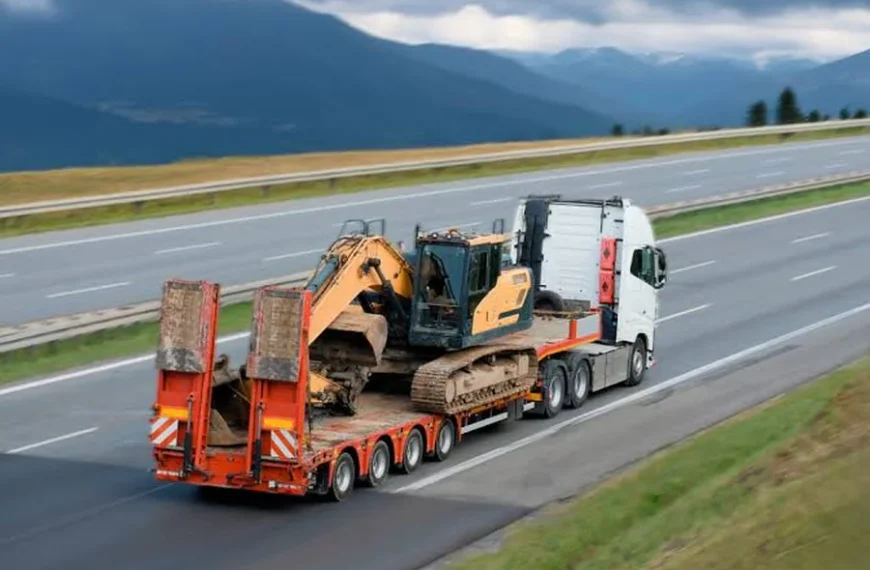
Moving an excavator, crane component, industrial vessel, or other over-dimensional machine is a project-planning task, not simply a freight booking. The right lowboy trucking arrangement can help lower loaded height and improve loading access, but it is only one part of a successful move.
Every decision affects the next one. A missed attachment measurement may change the trailer needed, which can alter axle weights, overall height, permit requirements, and the roads that remain available. Starting early gives the carrier, project manager, and site team time to resolve those issues before equipment and labor are waiting on a delayed shipment.
Why Oversized Transport Needs Early Planning
Ordinary freight commonly follows established lanes with predictable loading docks and standard equipment. Oversized equipment may require a specialized trailer, approved routing, escorts, restricted travel hours, utility coordination, and temporary traffic control. A plan that works on paper can still fail if a bridge restriction, narrow turn, low line, or soft delivery site is discovered too late.
Early planning also helps construction and industrial teams coordinate cranes, rigging crews, gate access, staging areas, and receiving personnel. The goal is not merely to get the load to the destination. It is to deliver it safely, legally, and in a condition that allows the next phase of the project to begin.
Step 1: Record the Load Details
Begin with verified dimensions and weights, preferably from manufacturer information and a physical inspection when practical. Do not rely on an old equipment sheet if attachments, guards, counterweights, or modifications have changed the final configuration.
- Total loaded length, width, height, and weight
- Axle spacing and expected weight distribution
- Center of gravity and securement considerations
- Pickup and delivery addresses, including access roads
- Removable attachments, booms, buckets, or counterweights
- Loading, unloading, and special handling requirements
Even a small measurement error can make an otherwise suitable route unusable. Confirm the dimensions after the equipment is configured for transport, not before.
Step 2: Match the Trailer to the Equipment
Trailer selection affects loaded height, ground clearance, turning behavior, axle loading, and the amount of space needed at both ends of the trip. A standard flatbed may suit machinery that is within practical height limits, while low-profile trailers, removable gooseneck trailers, and multi-axle configurations can be better suited to equipment with unusual dimensions or weight distribution.
The correct choice depends on the machine, route, loading method, and permit plan. For example, lowering deck height may improve overhead clearance, but the trailer setup still needs adequate clearance at rail crossings, driveways, and uneven jobsite approaches.
Step 3: Build a Route Around Real Road Conditions
Route planning should evaluate the entire trip, including local streets near the pickup point and the final mile into the delivery site. Review bridge postings, vertical clearances, lane widths, tight intersections, grades, railroad crossings, construction zones, utility lines, seasonal restrictions, and time-of-day limitations.
The Port of Long Beach’s 2026 heavy haul route upgrades illustrate why roadway geometry matters. Planned improvements include wider intersections, better turning radii, and increased clearances, all of which can determine whether large freight can move through a corridor efficiently.
Route Survey Priorities
- Verify bridge and pavement limitations for the planned axle configuration.
- Check whether turns can be completed without striking curbs, signs, poles, or parked vehicles.
- Identify overhead utilities, traffic signals, tree limbs, and temporary work-zone obstructions.
- Confirm that the planned route remains open close to the departure date.
Step 4: Review Permits and Travel Rules
Oversize and overweight permits are tied to the actual load, vehicle configuration, route, and travel dates. A permit issued for one state or local authority does not automatically authorize travel elsewhere. Requirements can also differ for escorts, signs, lights, travel windows, and holiday or weather restrictions.
- Identify every state, county, city, port, or road authority on the route.
- Submit complete dimensions, weights, axle information, and routing details.
- Confirm escort and traffic-control requirements.
- Review approved travel hours and restrictions before dispatch.
- Keep permits and any required supporting documents available during the move.
Step 5: Plan for Clearances and Escorts
Mapping tools are valuable, but they should support rather than replace professional route review. A field survey can confirm practical turning room, lane width, shoulder condition, overhead clearance, and obstacles that are missing from mapping data.
Escort vehicles may be required by permit conditions or useful for managing traffic around tight turns, narrow roads, and complex site entrances. Their role should be defined before departure, including communication procedures and responsibilities if the load must stop or reroute.
Step 6: Prepare the Pickup and Delivery Sites
A clear highway route does not guarantee a successful delivery. Confirm that gates are wide enough, approach roads are suitable, ground conditions can support the transport vehicle and lifting equipment, and the site has room to stage the load safely.
- Gate width, turning area, and overhead lines near the entrance
- Ground firmness and drainage conditions
- Crane, forklift, or rigging availability
- Receiving crew schedules and site-access procedures
- Temporary closures, permits, or traffic-control needs
Step 7: Add a Backup Plan
Weather, crashes, utility work, construction activity, and changing permit conditions can disrupt a move. Establish an alternate route or staging location where possible, maintain an updated contact list, and assign one person to check route conditions before departure. Clear decision points help the team respond quickly without improvising under pressure.
How Digital Tools Can Support Route Planning
Route-planning software can help teams organize load data, compare potential corridors, identify restrictions, estimate travel time, and track permit information. It is most useful when paired with current field observations and experienced review. Digital data may not capture a recently lowered utility line, new work zone, or jobsite condition.
Common Planning Mistakes to Avoid
- Using outdated measurements or forgetting removable attachments.
- Choosing a route only because it is the shortest.
- Requesting permits after the transport date is already fixed.
- Ignoring access conditions at the final delivery point.
- Failing to verify lifting equipment and crew availability.
- Operating without an alternate route or delay procedure.
Current Industry Lessons
Current planning discussions continue to emphasize early field data, route surveys, transport engineering, and communication among carriers, riggers, engineers, and project teams. The Specialized Carriers & Rigging Association’s heavy-haul risk reduction guidance highlights how incomplete surveys and late stakeholder alignment can create avoidable rework and delays before a move begins.
Conclusion
Oversized equipment transport succeeds when route research, accurate measurements, permits, trailer selection, site preparation, and contingency planning work together. Treat each move as a coordinated project from the first measurement through final unloading, and the delivery is more likely to remain safe, predictable, and on schedule.


