
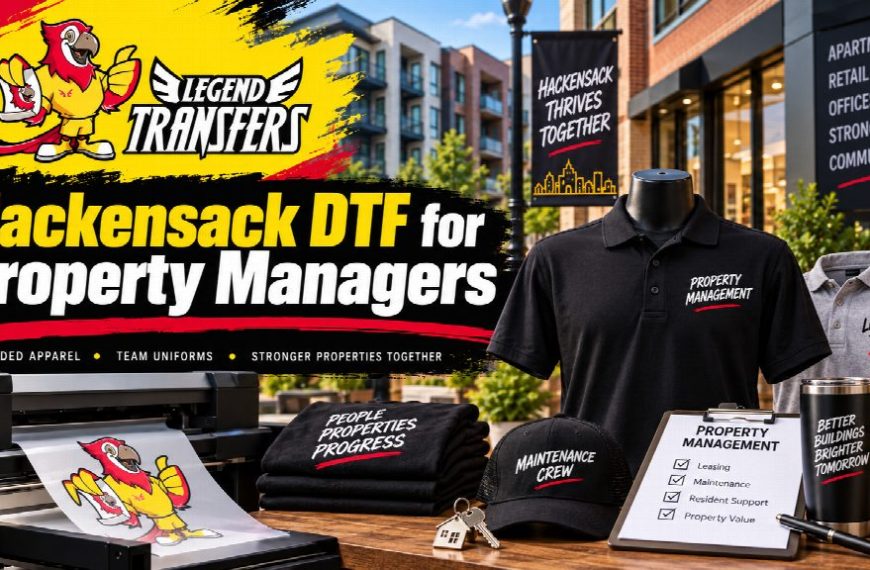
Property management creates a branding problem that is easy to underestimate. A building may involve leasing staff, maintenance employees, management personnel, outside vendors, contractors, and temporary crews. Tenants and visitors need to know who represents the property and who does not. At the same time, managers do not want to create a complicated apparel program that becomes difficult to update every time staffing or vendor relationships change.
That issue becomes increasingly relevant in a mixed-use environment. Hackensack continues to see redevelopment involving residential, retail, public-space, and commercial activity. More active properties create more moments in which staff identification matters: move-ins, inspections, maintenance visits, tenant events, building access, vendor coordination, and day-to-day customer service.
Start With Role Identification
The first question should not be what shirt looks best. It should be which roles actually need to be identifiable.
A property management office may have several groups operating inside the same building. Some interact with tenants every day. Others are primarily involved with maintenance or back-of-house work. Outside vendors may only be present for a few hours. If every group receives nearly identical apparel, the clothing stops helping people understand who is responsible for what.
A practical system can divide apparel into a few clear categories:
- Management and leasing staff
- Building maintenance employees
- Property operations personnel
- Temporary project or event staff
- Outside vendors who should remain visually distinct
This does not mean every category needs a completely different design. Small, intentional differences in wording, placement, or garment choice can make the system easier to understand without creating unnecessary artwork.
Avoid Overbranding Every Garment
Property apparel should solve an identification problem before it solves a marketing problem. Large promotional graphics may make sense for an event shirt, but day-to-day building operations usually benefit from simpler visual hierarchy.
A recognizable logo, readable role language, and consistent placement often matter more than adding extra graphics. The person approaching a tenant’s door for a scheduled maintenance visit should be easy to identify. The employee helping someone in a lobby should look connected to the property. The leasing representative meeting a prospective tenant should look professional without appearing to wear an event shirt.
This is where a disciplined apparel plan becomes more valuable than simply ordering branded clothing.
Plan for Staff Changes
Property teams are not static. Employees change roles, new personnel join, temporary help may be added, and vendors rotate. Apparel therefore needs to be easy to reproduce without rebuilding the entire order.
Managers can reduce friction by keeping approved artwork organized by role. A simple naming structure is often enough: property name, department or role, placement, and final version. Avoid saving several nearly identical logo files without clear approval status. When the next order is needed, the team should be able to identify the correct design immediately.
Businesses reviewing DTF transfers in Hackensack, NJ can approach the process this way: create a stable set of approved role designs first, then use those assets as repeatable production files.
Separate Daily Apparel From Projects
Mixed-use properties may occasionally need apparel for grand openings, tenant events, seasonal programming, renovation phases, or promotional activities. Those items should not automatically become part of the permanent staff system.
Keeping temporary projects separate protects the consistency of daily apparel. Management teams can approve a project-specific graphic without changing what maintenance or leasing staff wear every week. Once the event or project ends, the temporary artwork can be archived rather than accidentally becoming the default file used for future orders.
Think Beyond One Building
The system becomes even more important for managers responsible for multiple buildings or addresses. If every location develops its own apparel process independently, the organization can quickly end up with multiple logo treatments, different placements, inconsistent wording, and duplicate files.
A better model is to establish a common brand structure and then identify what genuinely needs to vary by property. In many cases, the primary brand can remain stable while only limited information changes. This reduces artwork management and makes it easier to order for a growing portfolio.
For larger or recurring programs, a wholesale DTF workflow can be considered as part of broader production planning, particularly when the goal is to maintain repeatable designs across multiple staff groups rather than create one-off promotional pieces.
Create an Approval Rule
Property managers should also decide who has final authority over apparel artwork. Without a defined approval point, leasing may use one logo, maintenance may use another, and an outside vendor may receive an outdated file from someone on the team.
A basic approval rule can prevent that. One person or department owns the final artwork. Only approved files are sent for production. Retired versions are clearly archived. New role labels are reviewed before being added to the system.
Keep the System Operational
The best property-management apparel program is not the most creative one. It is the easiest one to operate. Staff should be recognizable. Roles should make sense. Artwork should be controlled. Temporary projects should remain separate from permanent uniforms. New orders should not require another round of detective work to find the right logo.
For Hackensack property managers working in an increasingly active mixed-use environment, that kind of structure turns branded apparel from a recurring administrative problem into a simple operating tool.


