
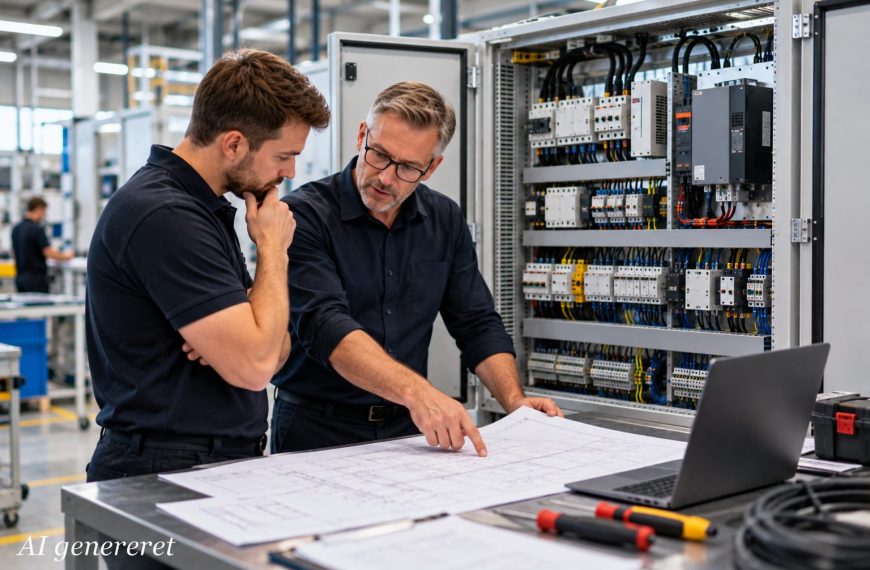
If you choose the wrong partner for electrical panel manufacturing, you typically discover it in the middle of a project—not before. Delivery delays, missing certifications, or a supplier that cannot handle modifications can bring an entire facility to a standstill.
Certifications Are More Than Paperwork
A persistent misconception is that certifications such as UL 508A and ISO 9001 are mostly administrative formalities. That is not the case. A UL 508A label means the panel has been built and documented in accordance with a U.S. safety standard for industrial control panels, with requirements covering wiring, spacing, and component placement. Without that label, you cannot sell or install control panels in the United States and Canada.
UL 891 covers switchboards and distribution panels for low voltage up to 600 V. If the panel is intended to distribute power safely throughout a facility, that is the standard to look for.
If your project involves exports to North America, ask a potential partner to document exactly what is certified and for which markets. SystemTeknik panels are certified to both UL 508A and UL 891 for the United States and Canada, combined with ISO 9001 for quality management and ISO 14001 for environmental management.
● Wiring and spacing requirements between components
● Component placement and proper installation practices
● Electrical safety testing and documented compliance
● Proper labeling so the panel can be traced and approved
Production Capacity Is About More Than Volume
Many procurement managers ask only one capacity question: can the supplier deliver the number of panels we need? Size is not the same as suitability.
Real capacity is also about flexibility. Can the partner handle a custom design, build a prototype, and run volume production under one roof? If those three phases are split among different providers, you lose time every time a project has to change hands.
Do not just ask how many panels a partner can build. Ask how many different types they can handle—and how quickly they can shift gears.
A Supplier Is Not the Same as a Partner
A common mistake is to treat the panel manufacturer as a pure production resource. But industrial electrical panels are rarely so simple that a design survives contact with the real world without adjustments.
A single-point-of-contact approach means one party follows the project from design and prototype through volume production and commissioning. You avoid the situation where the designer points to the factory, the factory points to the subcontractor, and you are left with a system that cannot be started up.
Problems typically occur during handoffs between phases, not within production itself. Determine early whether a potential partner takes coordinated ownership of the project.
● Who will be my dedicated contact from design through commissioning?
● Are design, prototyping, and volume production handled in-house or by subcontractors?
● Who is responsible if a panel fails testing during commissioning?
● How do you handle late-stage changes?
Costly Mistakes When Choosing a Partner
The most common mistakes can be anticipated:
● Overlooking certification requirements in the destination market, leaving the panels unable to be installed when they arrive
● Underestimating the need for adaptability, because the project almost always changes along the way
● Forgetting the partner’s financial stability, such as whether the company has an AAA credit rating
● Skipping reference checks and relying blindly on a sales meeting
● Underestimating documented experience in your specific industry, whether that is data centers, marine, or pharma
Missing certification requirements is the mistake with the most severe consequences. A panel without UL 508A cannot be commissioned in the United States. Financial stability seems abstract until a supplier shuts down in the middle of a five-year contract and leaves you without warranty support.
Financial Stability and Experience Matter
Price tells you nothing about whether the partner will still be around when you need spare parts five years from now.
SystemTeknik has more than 70 years of experience in electrical panels and an AAA credit rating. That is the kind of track record that determines whether a partner can support a long-term project.
When you put the criteria together, a clear basis for decision emerges: the right certifications for your market, genuine adaptability, a partnership model with end-to-end accountability, and financial stability that lasts throughout the project lifecycle. Evaluate a potential supplier against those four points, and you can identify problems before the project starts.


